

3-Tier Wire Shelving Units We Recommend for a Clutter-Free Space
2026-11-16
Most storage promises to hide clutter, but the best shelving actually helps you keep it from coming back. A 3-tier wire unit does that by keeping everything visible, ventilated, and within reach—no more mystery piles behind solid doors. We looked for the ones that stay stable under real weight, assemble without a headache, and still look tidy in a multipurpose room. The shortlist below features the models we’d genuinely use, including durable options from ZEOU that don’t wobble or rust after a few months.
What three tiers can hold that a single cabinet shelf usually can't
A single cabinet shelf tends to flatten your storage into one wide, shallow layer. Three tiers give you three distinct landing zones, so taller bottles, stacks of plates, and smaller jars are not forced to compete for the same strip of space. That separation means you are not constantly moving the coffee maker to reach the spice jars, and a stack of dinner plates does not have to share a surface with a bread bin.
The extra levels also handle weight and awkward shapes more gracefully. Heavy cast-iron pans can sit on the lowest tier, where the frame carries the load, while lighter things like boxes of tea or folded cloths stay within easy reach above. A single shelf usually forces you to choose between stacking everything or spreading it so thin that half the cabinet becomes unusable; three tiers let you keep that middle ground without blocking access to the back.
The wobble test we do before recommending any wire shelving unit
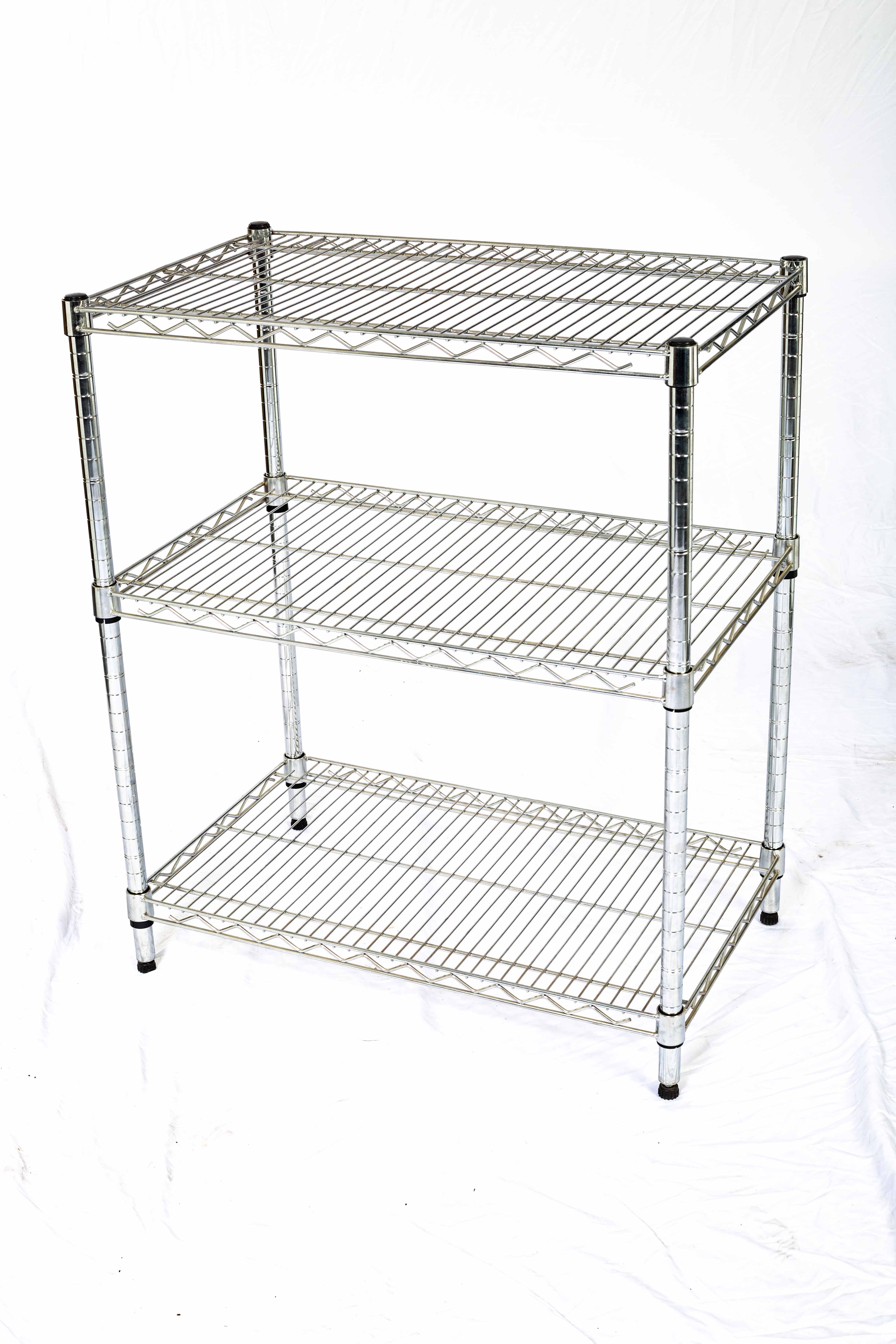
A quick nudge at the top corner tells us more than a spec sheet. The wobble test starts with the unit empty on the actual floor surface, not just on a showroom pad. We push lightly from the front, then from the side, and watch whether the frame twists, the feet shift, or the top sways independently. If it moves as one stiff piece, that's a pass. If it shudders and keeps vibrating after we let go, we start looking at levelers, floor unevenness, or a missing cross brace.
Then we repeat the test with a realistic load, because an empty shelf can feel solid while a loaded one walks across the floor. We place dense items on the upper level first, since that's where most people store heavier bins without thinking. A second push from each direction reveals whether the shelf needs a rear stabilizer, wall anchoring, or simply tighter sleeve connections. Only after that loaded pass do we suggest the unit for a specific space.
How open wire spacing keeps spice jars from tipping through the gaps
The gaps in an open wire shelf look like they would invite trouble, but the spacing is set specifically to catch the base of a standard spice jar before it can pitch forward. Instead of resting on a single thin rail, the jar sits across two or three wires at once, which spreads the load and keeps the bottom edge from dropping into the opening when you reach for something behind it.
That small bit of support makes a bigger difference than it seems. If the wires are too far apart, a jar only needs a tiny nudge to drop one corner into the gap, and once that corner sinks, the whole jar leans hard against its neighbor. With tighter spacing, the base stays level, so the jar may slide a little but it does not tip through. It also means you can pull one jar straight up without the ones beside it shifting into the empty slot.
At the same time, the open design still leaves enough clearance for air to move around the jars and for crumbs or spills to fall through to the surface below. You get the stability of a solid shelf without trapping dust under the jars, which is the main reason this kind of spacing works better than a flat panel for everyday spice storage.
Why baked-on finishes beat chrome in kitchens with real cooking messes
A chrome surface looks sharp until the first pan of bacon sends a fine mist of grease across the kitchen. Then every droplet sits there like a spotlight. Baked-on finishes, especially the lightly textured ones, do not broadcast splatter the same way. The surface breaks up fingerprints and oil smears, so the area around the cooktop stays calmer between wipe-downs.
It is not just about looks either. Real cooking throws acid around: lemon juice, tomato sauce, a splash of wine near the simmering pan. Those things can cloud or pit chrome over time. A baked-on finish handles that kind of contact without etching or losing its color, which matters when the mess is not wiped up immediately.
Cleaning is where the difference becomes obvious. Chrome needs buffing to look right, and even then streaks tend to linger. A baked-on finish usually comes back with warm water, a mild soap, and one pass of a cloth. For a kitchen that actually gets used, that low-maintenance surface makes more sense than trying to keep chrome looking like a mirror.
Assembly quirks we found in the instructions and how to work around them
The first real snag was the cam lock spacing in the side panel diagram. The printed guide shows the holes drilled 32 mm from the front edge, but the actual panel has them at 40 mm. Forcing the cams in at the printed measurement pulls the panel out of square. We ended up clamping the panel to the top board, marking the factory holes with a pencil, and ignoring the numbers in the booklet. That one change saved more time than any other fix.
Another quirk appeared with the leg levellers. The instructions have you thread them all the way in before attaching the base, but two of the inserts were seated slightly deeper in the legs. That meant the levellers bottomed out at different heights and the unit rocked. Backing each leveller out two full turns before fitting the base, then adjusting from there, gave a much more even starting point.
The hinge screws were the last oddity. The booklet calls for a power driver on the middle speed setting, but the screws are soft enough to cam out at that speed. Using a hand driver for the final turn and keeping light inward pressure stopped the heads from stripping. Not a major rework, but it is the kind of small thing that is easy to miss until a hinge starts sagging.
Placing the rack so it clears the walkway and still keeps everything in reach
A common mistake is treating a rack as just another storage unit pushed against the wall. Instead, think of it as a traffic director. Walk the actual path you use every day, then place the rack slightly outside the natural swing of your stride. Leave enough room so a loaded laundry basket or a hurried morning can pass without a shoulder bump, but keep the front edge close enough that you can grab a coat or keys without taking more than one step sideways.
Height matters as much as footprint. If the rack has a top rail or hooks, make sure it does not extend into the space above a bench or a narrow hallway turn where taller household members might brush against it. A rack that clears the walkway at waist level but juts out at eye level still feels like an obstacle. Tuck the upper shelf or hanging bar toward the wall side of the unit, or angle the whole rack so the visible corner points away from the main route.
Finally, test the reach factor before you commit. Stand in the spot where you usually pause when coming through the door, and see whether the most-used items, such as a jacket, umbrella, or dog leash, are within a comfortable arm sweep. If you have to lean or change direction sharply, shift the rack a few inches and test again. The goal is a setup that disappears into the room when you are moving and reappears exactly where your hand already wants to go.
FAQ
The open wire design lets air and light pass through, so a corner doesn't feel boxed in. You can also see what's on every level at a glance, which cuts down on forgotten items hiding at the back.
Many are rated for a few hundred pounds per shelf when the load is spread evenly. I'd still keep the heaviest things on the bottom tier and check the manufacturer's weight limit before loading up a garage or pantry.
Most use a simple post-and-sleeve or clip system that goes together by hand in ten or fifteen minutes. A rubber mallet helps settle the shelves evenly, but you won't need a screwdriver unless the model has locking casters.
Look for a chrome, zinc, or epoxy-coated finish. Epoxy-coated steel tends to hold up better in damp areas, though I would not leave most wire units in direct rain. Wiping them down occasionally keeps rust from getting a foothold.
Use shelf liners made for wire racks, thin plastic cutting boards, or small trays. For pantry items, grouping bottles in shallow bins works just as well and still keeps the airy look.
Yes, with many models you can move the shelves in one-inch increments along the posts. That's useful if you later decide to store tall cereal boxes on one level and short spice jars on another.
Besides pantries and garages, they're handy in a kid's room for toys, in a home office for supplies, or even as a plant stand near a bright window. The open shelves don't block much light, which houseplants seem to appreciate.
Most units include adjustable leveling feet, and that small adjustment makes a noticeable difference. If you're using casters, get ones with locks, especially on tile or wood floors.
Conclusion
A three-tier wire unit earns its place when you stop treating it as a backup shelf and start loading it with the awkward stuff a single cabinet shelf often can't hold: bulky mixer heads, tall bottles, stacked prep bowls, and the cutting boards that never quite fit behind a door. Before any model gets a nod, we push and pull it side to side on a hard floor; if the frame twists or the feet lift, it doesn't make the cut. The open wire spacing is tight enough that standard spice jars sit flat without one corner dropping through, which sounds minor until you've fished a bottle out from behind the bottom rung.
Kitchens with real cooking messes need more than chrome, so we lean toward baked-on finishes that shrug off oil spatter and tomato sauce without rusting or peeling near the rivets. Assembly instructions are not always honest about the order of operations—several manuals tell you to tighten everything before the top shelf is seated, which locks the frame out of square. Leave the bolts loose until the shelves are in place, then snug them down. For placement, keep the rack shallow against the wall rather than angled toward the center of the room; that clears the walkway while the lower two tiers stay close enough for grabbing oils, vinegars, and dry goods without a stretch.
Contact Us
Contact Person: Alin
Email: [email protected]
Tel/WhatsApp: +86 15015291051
Website: https://zeoumetal.com/