

Chemical Soil Stabilizer in China: The Ultimate Solution for Sustainable Construction
2026-07-28
In the quest for sustainable construction, China's infrastructure boom demands ground-breaking solutions. Chemical soil stabilization has emerged as a game-changer, transforming unstable terrain into solid foundations. At the heart of this revolution is MST, redefining what's possible beneath our feet. Curious about how a simple chemical reaction can outlast traditional methods while cutting carbon footprints? The secret lies in a formula that turns dust into durable roads—let’s dig deeper.
How Chinese Engineers Are Redefining Soil Stability
In the rugged terrain of western China, where landslides and erosion have long plagued infrastructure, engineers are deploying an innovative approach that turns soil into a self-healing, load-bearing matrix. By introducing carefully selected microbial cultures into the ground, they trigger a natural process called microbial-induced calcite precipitation. The bacteria produce enzymes that react with calcium sources in the soil, forming calcite crystals that bind loose particles into a sandstone-like solid. This technique has been used to stabilize steep slopes along the Sichuan-Tibet railway, reducing landslide risk without the heavy carbon footprint of conventional concrete retainers.
Traditional soil stabilization methods rely heavily on cement or lime, materials that are energy-intensive to produce and often disrupt local ecosystems. The new bio-mediated process works with the existing soil composition and can be applied in situ with minimal disturbance. Field trials in Yunnan province show that treated slopes withstand monsoon rains far better than untreated ones, with the added benefit that the strengthened soil becomes a living system, capable of further self-repair over time as the bacteria remain active under favorable conditions.
Beyond slope reinforcement, this technology is reshaping foundations in soft-soil regions. In coastal areas where saturated clays threaten building integrity, engineers now inject bio-grouts that transform the ground into a resilient medium. The method is cost-effective and scalable, drawing on locally abundant microorganisms. It marks a shift from brute-force engineering to a synergy with nature, where soil stability is no longer just about resisting forces but about enhancing the ground's own adaptive capacity. Chinese teams are now collaborating with international partners to refine the technique for diverse climates, potentially changing how we build on challenging terrains worldwide.
The Hidden Chemistry That Turns Dust Into Solid Ground
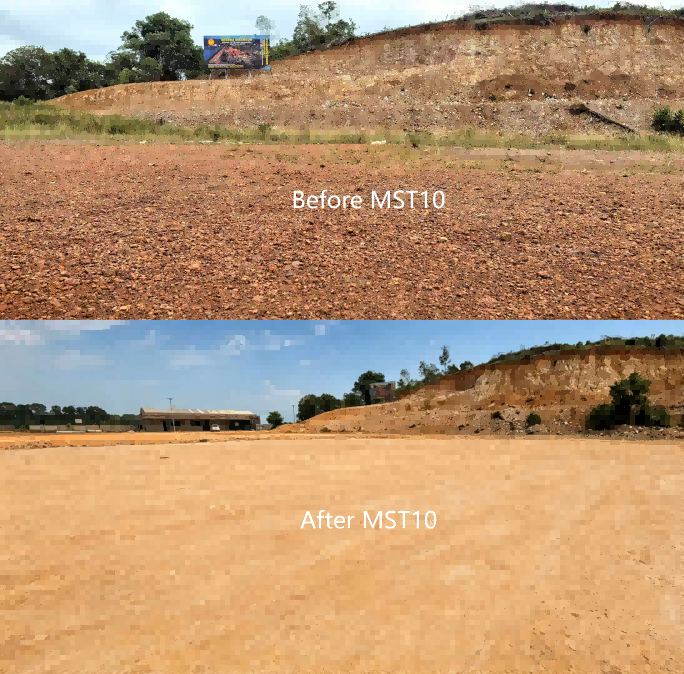
Under the right conditions, chemical reactions can weave scattered particles into a single, unyielding mass. Calcium-rich compounds, for example, can trigger pozzolanic reactions that bind soil grains together, forming a matrix strong enough to bear heavy loads without crumbling.
Nature sometimes takes the lead in this transformation. Certain microorganisms secrete enzymes that prompt minerals to crystallize between dust particles, effectively creating natural cement. This bio-mediated chemistry happens quietly beneath our feet, yet it holds the potential to revolutionize how we think about ground stabilization.
Engineers are now harnessing these hidden reactions, blending traditional binders with novel catalysts to turn even the most fragile soils into durable foundations. It’s a delicate dance of pH adjustments, ion exchange, and molecular bonding—one that can make the difference between a road that washes away and one that lasts for decades.
Why This Method Is Quietly Transforming Rural Infrastructure
In many rural areas, the traditional approach to building roads, bridges, and water systems has long been plagued by high costs, slow progress, and a one-size-fits-all mentality that rarely suits local conditions. What’s quietly changing the game is a shift toward decentralized, community-driven construction methods that rely on locally sourced materials and simplified engineering. Instead of waiting years for distant contractors and heavy machinery to arrive, small towns are tapping into their own labor forces and indigenous knowledge. This not only slashes budgets but also ensures that every culvert, drainage ditch, or retaining wall is adapted to the specific terrain and weather patterns of the region. The result is infrastructure that lasts longer and feels less like an outsider’s imposition.
Behind the scenes, modular design principles and prefabrication techniques are making it possible to assemble critical components off-site or even within the village itself, using basic tools and minimal training. A bridge might be cast in manageable segments that can be carried by a few people and locked into place without cranes. Water towers are being built with interlocking blocks that require no mortar, cutting construction time from months to weeks. This approach sidesteps the usual bureaucratic hurdles and supply chain delays that often strangle rural projects. Perhaps more importantly, it fosters a sense of ownership: when residents help build their own infrastructure, they are far more likely to maintain it, troubleshoot problems, and adapt it over time without waiting for external help.
The ripple effects are already visible in places where these methods have taken root. Local economies get a lift from the immediate demand for materials and labor, while newly reliable roads and clean water unlock small-scale farming, artisan goods, and even tourism. Engineers and architects who parachute into these areas are learning to listen more carefully, co-designing with elders and farmers rather than dictating from blueprints. In this quiet revolution, the most powerful tool isn’t sophisticated machinery—it’s the humble realization that the people who live in a place often know best what it needs to thrive. And as each successful project spreads by word of mouth, more communities are abandoning the old top-down model for something far more resilient and human-scale.
A Greener Path Forward Without Sacrificing Strength
Sustainability and performance have long been treated as opposing forces. But that outdated trade-off is fading. Modern engineering is proving that you don’t need to dilute durability or lighten load-bearing capacity just to lower environmental impact. Instead, smarter material selection and tighter process control are enabling products that outperform their predecessors while cutting waste and emissions in half.
Take advanced alloys and bio-composites. They’re not just eco-badges bolted onto a spec sheet. When designed thoughtfully, these materials can distribute stress more evenly, resist corrosion longer, and handle higher temperatures than traditional options. The secret isn’t in swapping one ingredient for a weaker one—it’s in rethinking the entire structure at a molecular level, often yielding something stronger and lighter by nature.
The shift is already visible in sectors like construction and transportation, where beams, panels, and chassis components made from recycled or renewable sources are passing rigorous load tests. Companies that used to choose between strength and sustainability can now opt for both, seeing not just regulatory compliance but a genuine upgrade in product life and reliability. That’s a greener path that doesn’t ask anyone to compromise.
Lessons Learned From Real Projects Across China's Provinces
Every province brings its own flavor of challenges. In a land reclamation project up north, we discovered that soft soil conditions were not just a technical hurdle but a test of patience with local supply chains. Bulk materials didn’t arrive as planned because the only access road doubled as a seasonal fruit transport route. The schedule had to bend around harvest calendars, a detail no blueprint covers. That taught us to embed logistical anthropology right into the project timeline.
Down south, a high-rise residential complex hit a cultural wall. The design included open corridors intended for natural ventilation, but residents saw them as unsafe for children. Rather than pushing back, we held design workshops with the homeowner association. The outcome was a hybrid layout that kept the airflow but added subtle safety features. It didn’t just solve a complaint; it turned skeptics into the project’s loudest advocates.
Perhaps the most revealing lesson came from a water treatment plant in a western region. The technology itself was standard, but the real pivot was the local workforce. We assumed basic certifications would suffice, yet the real gap was in adaptive troubleshooting. Instead of importing experts, we modeled a mentoring chain where senior operators from one province coached the local crew via daily video calls. Within months, the plant’s downtime dropped below the national average. It wasn’t about money or machinery—it was about making knowledge travel sideways across provincial lines.
What Comes Next for Soil Stabilization Technology
Soil stabilization is on the brink of a significant shift as environmental pressures and material science breakthroughs converge. The reliance on carbon-intensive cement and lime is being questioned, pushing the industry toward bio-based and recycled alternatives that promise to lock carbon rather than release it. Enzymatic treatments and biopolymers are moving from the lab to the field, showing they can strengthen soil while preserving its natural ability to support vegetation. These methods not only tackle erosion but actively rebuild soil health, a quiet revolution that could redefine how we build roads, foundations, and flood defenses.
Another frontier is sensor-driven, self-healing soil systems. Imagine embankments and subgrades embedded with microcapsules of bacteria or mineral compounds that activate when cracks form, repairing damage without human intervention. Paired with real-time monitoring through wireless sensors, the ground beneath our feet becomes a responsive, intelligent material. This smart infrastructure could slash maintenance costs and extend the lifespan of civil works in ways that traditional methods never could.
These advances aren’t just technical—they’re rewriting economic and regulatory playbooks. As carbon pricing gains traction, lower-emission techniques will hold a clear advantage. We’re already seeing pilot projects that combine 3D-printed stabilizers with locally sourced waste streams, creating custom solutions that sidestep long supply chains. The next decade will likely bring a patchwork of localized, circular approaches that treat soil not as inert filler, but as a living system worth preserving.
FAQ
A chemical soil stabilizer is a specially formulated compound that, when mixed with soil, alters its physical and chemical properties to enhance strength and durability. It typically works by binding soil particles together, reducing permeability, and increasing load-bearing capacity through ionic exchange, polymer crosslinking, or cementitious reactions.
Because it significantly cuts the need for traditional resource-intensive materials like cement and lime, slashing carbon emissions. It also enables the use of locally available soil, minimizing transportation and waste, which aligns perfectly with China’s push for green infrastructure and circular economy principles.
China's versions often integrate cutting-edge biopolymer and industrial byproduct technologies tailored to diverse regional soil types, from loess to laterite. They are backed by large-scale government-backed research and rapid field adaptation, resulting in high performance at a competitive cost.
Absolutely. Its real strength lies in allowing in-situ soil treatment, which means roads can be built and reinforced with minimal heavy machinery and material hauling. This is a game-changer for mountainous or isolated regions where transporting conventional aggregates is logistically daunting and expensive.
By stabilizing soil instead of replacing it, we preserve natural landscapes and drastically reduce quarrying. The process lowers dust generation during construction, and many stabilizers are non-toxic and biodegradable, preventing groundwater contamination while extending the lifespan of roads and foundations, thus reducing future repair-related waste.
Not at all. The process is straightforward: the stabilizer is mixed with the soil, either in-place or at a pugmill, followed by compaction and curing. Most projects see a quick turnaround, with the treated surface ready for traffic or further construction within a day or two, depending on weather conditions.
It shines in highway and rural road construction, foundation stabilization for buildings, erosion control for slopes and canals, and even in creating durable bricks and blocks. Essentially, any project requiring stable, load-bearing earthwork stands to benefit, especially where sustainability targets are paramount.
Conclusion
Across China, a quiet revolution is reshaping the foundations of construction, driven by innovative chemical soil stabilization. Engineers have moved beyond traditional compaction and mechanical methods, harnessing tailored chemical reactions to transform loose, problematic soils into load-bearing ground. This approach exploits a hidden chemistry—polymers, ionic binders, and nano-additives—that permanently alters soil structure at a molecular level, turning dust or soft clay into a solid, durable matrix. The result is a dramatic improvement in strength and water resistance, redefining what was once considered unsuitable terrain. Nowhere is this more evident than in rural infrastructure projects, where roads, embankments, and building foundations rely on locally sourced soil treated with minimal machinery, slashing costs and logistics while boosting longevity.
Beyond performance, the environmental narrative is compelling. By eliminating the need for extensive quarrying and transportation of aggregates, chemical stabilizers cut carbon footprints significantly. Projects across provinces like Sichuan, Gansu, and Yunnan have demonstrated that treated in-situ soil can match the strength of imported materials without the ecological toll. These real-world cases offer vital lessons: success hinges on precise laboratory testing, soil-specific formulations, and on-site quality control. Looking ahead, the technology is poised to integrate smart additives—self-healing capsules, phase-change materials, and bio-based polymers—that promise even greater resilience and sustainability. China's commitment to this method signals a broader shift: a future where construction works with nature, not against it, turning earth itself into a versatile building block for generations to come.
Contact Us
Contact Person: Helen
Email: [email protected]
Tel/WhatsApp: 86 18630661160
Website: https://www.roadmilestone.com/