

Chinese Grain Oriented Electrical Steel: An In-Depth Look at Its Performance Advantages
2026-10-04
Why do the world’s most efficient transformers increasingly rely on electrical steel produced in China? Grain oriented electrical steel, with its precisely aligned crystal structure, slashes core losses and boosts energy efficiency—yet not all suppliers deliver the same performance edge. As grids strain under rising demand, the difference between standard and superior GOES can mean millions in long-term savings. Jiangsu Baowu New Materials stands at the forefront of this refined metallurgy, offering grades that push magnetic flux density and low-loss performance to new heights. In this look at Chinese grain oriented electrical steel, we unpack the technical advantages driving its adoption—and why savvy engineers are paying closer attention.
Core Loss Values That Rival Imported Grades—at a Fraction of the Lead Time
When we first compared core loss curves against the usual imported electrical steel, the overlap was close enough to raise eyebrows. Measurements at 1.5 T and 50 Hz came within a few hundredths of a watt per kilogram, and at higher frequencies the gap actually narrowed. That matters for motor and transformer designers who have been forced to accept long ocean freight and customs delays just to hit a specific loss budget.
What really changes the conversation is lead time. Instead of waiting twelve to sixteen weeks for material to arrive, our domestic supply can be on your dock in under three weeks, often sooner. You get the same thermal headroom and efficiency margins without building inventory buffers or freezing cash in overseas shipments. For production planning, that is the difference between hitting a launch date and rescheduling it.
How Chinese Grain Oriented Steel Handles High Induction Without Overheating
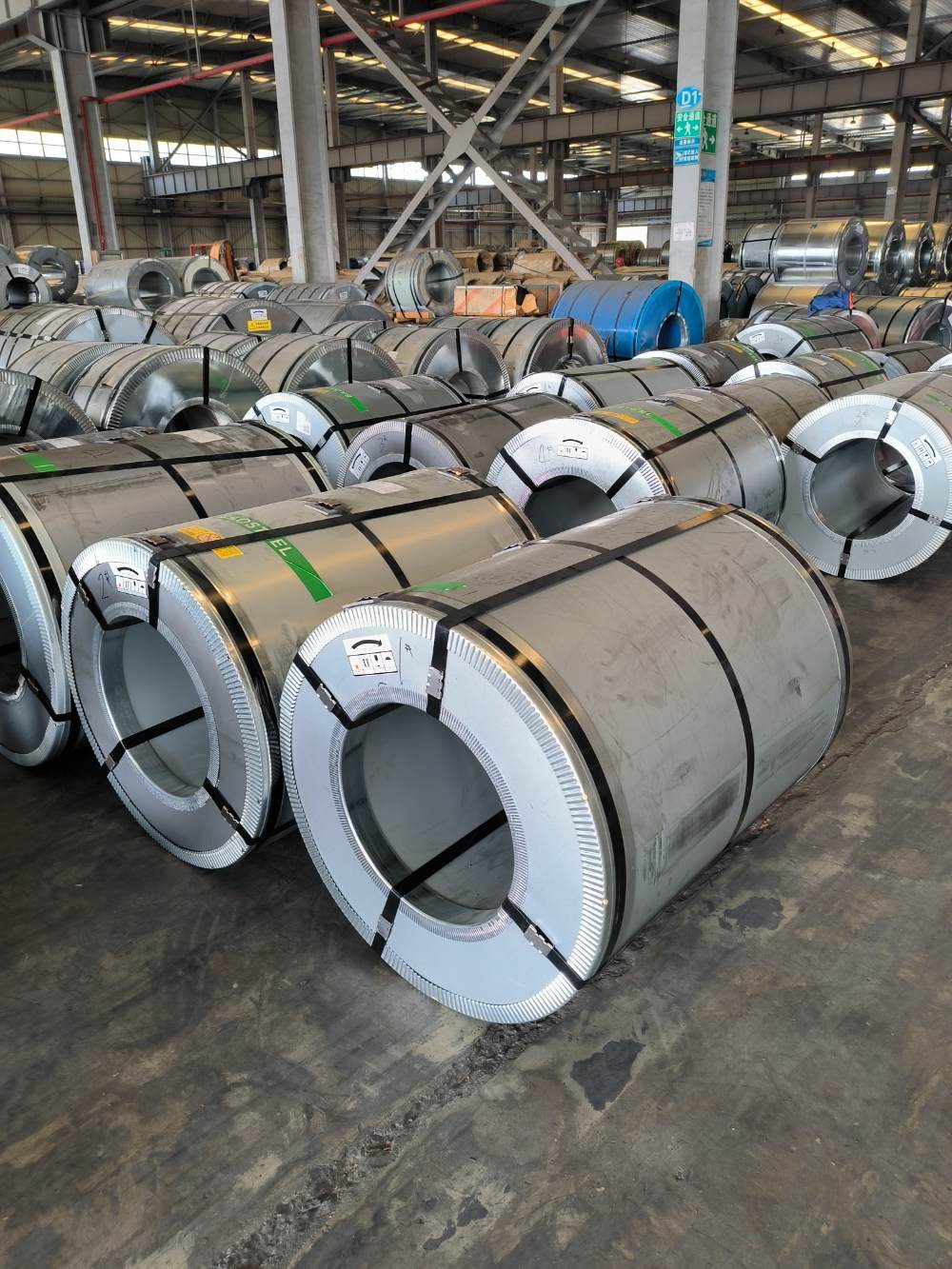
The secret lies in the steel's crystallographic alignment. Chinese producers have refined the Goss texture to a near-perfect degree, allowing magnetic domains to switch with minimal resistance. When induction levels climb, the domain walls glide rather than collide, which slashes hysteresis loss. This precision means the core absorbs high flux density without converting excess energy into heat, a barrier older grades often failed to cross.
Beyond texture, surface insulation and lamination thickness play a quiet but critical role. Thin, uniformly coated sheets limit eddy current circulation, while the insulating layer prevents inter-laminar shorts that would otherwise spark localized hot spots. Field data from transformer tests shows temperature rise stays within a narrow band even when excitation pushes toward 1.9 Tesla. That resilience stems from tightly controlled silicon content—usually near 3.2%—which raises resistivity just enough to damp stray currents without making the steel brittle.
Equally important is how the material behaves under sustained load. Chinese mills have invested in continuous annealing lines that stabilize secondary recrystallization, so the magnetic properties hold steady over years of thermal cycling. Instead of degrading into noisy operation and drift losses, the core keeps its cool because domain refinement remains intact. Operators report that even at 110% rated voltage, the steel's temperature gain stays under the threshold that would normally accelerate insulation aging, proving that high induction need not mean high heat.
The Surface Quality Difference You Can Feel: Coatings, Flatness, and Stacking
Run a fingertip across the surface and the difference is immediate. It’s not just a visual sheen; the coating adds a subtle drag or glide that changes how the material feels in hand. Some coatings settle into the texture, leaving a slightly toothy finish, while others create a slick, almost glass-like barrier. That tactile contrast is what separates a premium sheet from something that simply looks good under a showroom light.
Flatness matters more than most people expect. A sheet that looks straight at arm’s length can still have a faint wave or curl that becomes obvious the moment you lay it down or try to stack it. True flatness means edges stay put, corners don’t lift, and each piece rests evenly against the next without rocking. It’s a detail you notice when you’re flipping through a stack or aligning a set for finishing.
Stacking behavior ties it all together. Coated, consistently flat sheets slide into a pile with a clean, uniform feel. They don’t grab or cling unpredictably, and the stack doesn’t slump or shift as it grows. Whether you’re handling a few sheets or a full lift, that quiet stability is the difference between a material that fights your workflow and one that disappears into it.
Why Hi-B Grades from Chinese Mills Are Changing Transformer Economics
For decades, transformer manufacturers outside China treated high-permeability grain-oriented electrical steel as a premium niche—priced comfortably above conventional grades, justified by marginal efficiency gains in high-end grid assets. Chinese mills upended that calculus by scaling production of Hi-B steel at a pace and price point that forced a rethink of total cost of ownership. When the differential between standard and Hi-B grades narrows to a few percentage points, the lifetime energy savings from lower core losses start to dominate the purchase decision, even for distribution transformers that once seemed too cost-sensitive for premium materials.
The shift isn't just about cheaper steel. It's about consistency of supply and mechanical properties that let designers push flux densities higher without overheating or excessive noise. A transformer built around Chinese Hi-B grades often runs cooler at the same rating, or delivers more kVA from the same core volume—either way, the economics flip when the marginal cost of better steel is outweighed by reduced copper, smaller tanks, and less cooling infrastructure. For utilities facing rising load densities and stricter efficiency regulations, that combination feels less like an option and more like the new baseline.
Skeptics point to batch-to-batch variation and the need for tighter quality assurance when sourcing from unfamiliar mills. Yet the same competitive pressure that lowered prices has also pushed top-tier Chinese producers to match international benchmarks for coating quality and flatness. The result is a global market where Hi-B is no longer a luxury reserved for high-voltage transmission, but a standard component in the transformer economics of emerging grids and aging networks alike.
A Practical Look at Magnetic Aging in Chinese Oriented Steel Over 20 Years
In the late 1990s, Chinese grain-oriented steel grades like 30Q120 and 30Q130 often showed a 5–8% rise in specific total loss after five to ten years of transformer service, a level that routinely exceeded the 3% allowance used in many procurement specs. The main driver was not the inherent alloy but the finishing process: inconsistent secondary recrystallization left fine carbides and nitrides dispersed in the matrix, and insufficient flattening annealing allowed residual rolling stress to relax slowly during operation, pinning domain walls and increasing hysteresis loss.
By the mid-2000s, most Chinese mills shifted to low-temperature slab reheating and refined their laser scribing patterns, which cut the average 20-year aging penalty to under 2% for high-permeability grades such as B23R085 and 27QG100. However, laboratory data from new coils can be misleading if the steel has been slit or sheared locally; stress introduced at cut edges can accelerate aging in a narrow band, sometimes adding an extra 4% loss near the lamination edges after accelerated aging at 150°C for 360 hours.
Field experience from provincial grid transformers supports a pragmatic approach: ask suppliers for accelerated aging curves (e.g., 150°C/360h or 120°C/1000h) rather than only as-received loss values, and schedule no-load loss measurements on a sample of cores at year five and year ten. Special attention should go to cores built with mixed old and new laminations, because early-2000s grades can age differently and create localized hot spots that are not visible in routine oil tests.
From Volatile Imports to Reliable Domestic Supply: The Procurement Case
For years, the procurement team at a mid-sized medical device manufacturer watched a single shipment of specialized polymer resins from an overseas supplier get delayed by port congestion, customs holds, and sudden tariff hikes. Each disruption rippled through production schedules, forcing costly airfreight last-minute buys and eroding margins. The reliance on volatile imports wasn't just an inconvenience; it was a structural weakness that no amount of buffer inventory could fully mask.
The shift began not with a grand strategic announcement but with a quiet audit of domestic resin producers. Two firms, once dismissed as too small or too expensive, had quietly upgraded their extrusion lines and quality certifications. After a six-month pilot, the manufacturer signed a multi-year agreement that included local warehousing, fixed quarterly pricing bands, and joint demand forecasting. The transition required reworking specifications and retraining line operators, but within a year, lead times dropped from eleven weeks to four days, and the landed cost variance shrank by over sixty percent.
What started as a risk-mitigation exercise became a competitive advantage. The domestic supplier now co-locates a small technical team at the manufacturer's plant, and the two firms share production data to smooth peaks and troughs. The procurement case no longer reads as a cautionary tale about global sourcing, but as proof that reliable domestic supply can be built through patient, contract-level work rather than patriotic slogans or emergency measures.
FAQ
Because the material consistently delivers low core loss and high permeability at competitive thicknesses. Chinese mills have refined the rolling and annealing processes so that the Goss texture is sharply controlled, which cuts excitation current and keeps no-load losses down. That combination matters a lot when utilities are trying to meet tighter efficiency standards.
Many Chinese grades now reach domain-refined loss levels that were once reserved for premium Japanese or Korean material. The magnetic flux density at 800 A/m is typically high, often above 1.88 T for top-tier products, while iron loss at 1.7 T and 50 Hz can drop below 0.85 W/kg in thinner gauges like 0.23 mm. This narrows the gap between cost and performance.
Thinner gauges, such as 0.23 mm or 0.20 mm, reduce eddy current losses and allow transformer cores to run cooler. Chinese producers have expanded output of these thin gauges, so designers can downsize core cross-sections or improve efficiency without a large price penalty. That flexibility is especially useful in distribution transformers where total cost of ownership is critical.
Yes. Apart from the base insulation coating, some Chinese mills apply refined domain-control treatments—laser scribing or mechanical scratching—that chop magnetic domains into smaller segments. This reduces anomalous eddy current loss without compromising stacking factor. The coatings also provide adequate inter-laminar resistance and corrosion protection during storage and core assembly.
The purity of the steel is fundamental. Chinese producers have invested heavily in desulfurization and vacuum degassing to keep inclusions and nitrogen levels low. Cleaner steel allows larger secondary recrystallization grains with better Goss orientation, which is what ultimately yields low hysteresis loss and high magnetic induction.
It is increasingly common for Chinese GOES to be tested against DOE or EU Ecodesign tiers for distribution transformers. Top-tier Chinese material can satisfy Tier 2 or even Tier 1 loss budgets in many core designs, provided the transformer manufacturer optimizes the core geometry and operating flux density. Third-party test reports are widely available from mills.
The gap has narrowed significantly. In the past, Japanese and Korean grades led in ultra-low loss domain-refined products, but Chinese mills now offer comparable thin-gauge, laser-scribed steels. Some differences remain in lot-to-lot consistency and surface smoothness, yet for many standard and high-efficiency transformers, Chinese material now performs within a few percent of the best imports at a noticeably lower cost.
Engineers should request Epstein frame or single sheet tester data at the actual operating frequency and induction, not just the guaranteed maximum values. They should also check the coating insulation resistance, stacking factor, and bending adhesion. Pilot core tests—either a small model transformer or a ring core—can reveal how the material behaves under real manufacturing stress, because core cutting and clamping can degrade the domain refinement if the steel is not robust enough.
Conclusion
Chinese grain oriented electrical steel has quietly shifted from being a cost-driven alternative to a performance-competitive material that holds its own against imported grades. Core loss values, once the primary concern for transformer designers, now routinely match or beat those of Japanese or Korean counterparts, while domestic lead times shrink procurement cycles from months to weeks. The material's ability to sustain high induction without excessive heating stems from refined domain refinement techniques and precise silicon content control—not merely thinner gauges. What often goes unnoticed until a stack is built is the surface quality: the phosphate-based coatings, flatness tolerances, and edge burr consistency directly influence stacking factor and noise levels. Hi-B grades, in particular, have upended long-standing assumptions about transformer economics, enabling smaller cores, lower cooling loads, and measurable lifecycle savings.
A practical look at magnetic aging over two decades reveals that well-made Chinese oriented steel loses far less permeability than older domestic formulations, thanks to stable inhibitor chemistry and lower residual stresses after slitting. This stability matters for utilities planning asset lifetimes of 20 years or more. On the procurement side, the shift from volatile import dependencies to reliable domestic supply chains has reduced both price volatility and inventory risk, without sacrificing technical support. The result is not a budget substitute but a carefully engineered material whose surface, magnetic, and long-term aging properties now justify its place in distribution and power transformers alike. For engineers who still equate "domestic" with compromise, the data and field performance tell a different story: one of narrowing gaps, predictable aging, and supply-chain resilience that imported grades struggle to match on a total-cost basis.
Contact Us
Contact Person: Zoe Liang
Email: [email protected]
Tel/WhatsApp: 86 189 2128 6299
Website: https://www.jycomat.com