

High-Speed Door Factory: Crafting Reliable Rapid Doors for Modern Industry
2026-07-20
In today's fast-paced industrial landscape, every second counts—and your facility’s doors shouldn’t be the bottleneck. At NORTON, we engineer rapid doors that don’t just open and close; they synchronize with your workflow, boosting efficiency, safety, and climate control. But what truly sets a high-speed door factory apart in a market flooded with options? It’s the fusion of relentless testing, precision manufacturing, and a deep understanding of modern logistics that turns a functional entryway into a silent partner in your operation’s success. In this post, we pull back the curtain on how NORTON crafts doors that outpace expectations—and why that matters for your bottom line.
Protecting Production: Why Speed Doors Are More Than Fast Openings
Beyond their rapid cycle times, speed doors are engineered as integral components of a secure production environment. They act as a physical barrier against contaminants, dust, and temperature fluctuations, preserving product integrity in industries like food processing, pharmaceuticals, and electronics. The swift open-and-close action limits the exchange of air between zones, reducing the load on HVAC systems and keeping cleanrooms within specified tolerances. This tight environmental control directly prevents costly batch rejections and maintains consistent quality, proving that speed is just the visible part of a much deeper protective function.
Another often-overlooked role is in safeguarding personnel and equipment from collisions and workflow disruptions. Advanced models come with breakaway bottom edges, motion sensors, and light curtains that instantly reverse the door upon detecting an obstacle, dramatically cutting the risk of injury. In busy warehouses or manufacturing floors where forklifts and automated guided vehicles (AGVs) move constantly, these doors separate human traffic from heavy machinery without creating bottlenecks. The result is a seamless flow that doesn’t compromise on safety, and that reliability keeps operations running smoothly around the clock.
Durability under high-use conditions further sets modern speed doors apart. Built with reinforced fabrics, robust guides, and wear-resistant seals, they withstand hundreds of daily cycles without faltering—minimizing downtime and maintenance calls. The self-repairing feature found in some designs, where the curtain automatically re-inserts into the side guides after an impact, is a game-changer for facilities that cannot afford interruptions. By choosing a door solution that prioritizes resilience and intelligent design, manufacturers effectively shield their production lines from external threats and internal mishaps, turning a simple opening into a strategic asset.
Built to Cycle: The Material Science of Industrial Rapid Doors
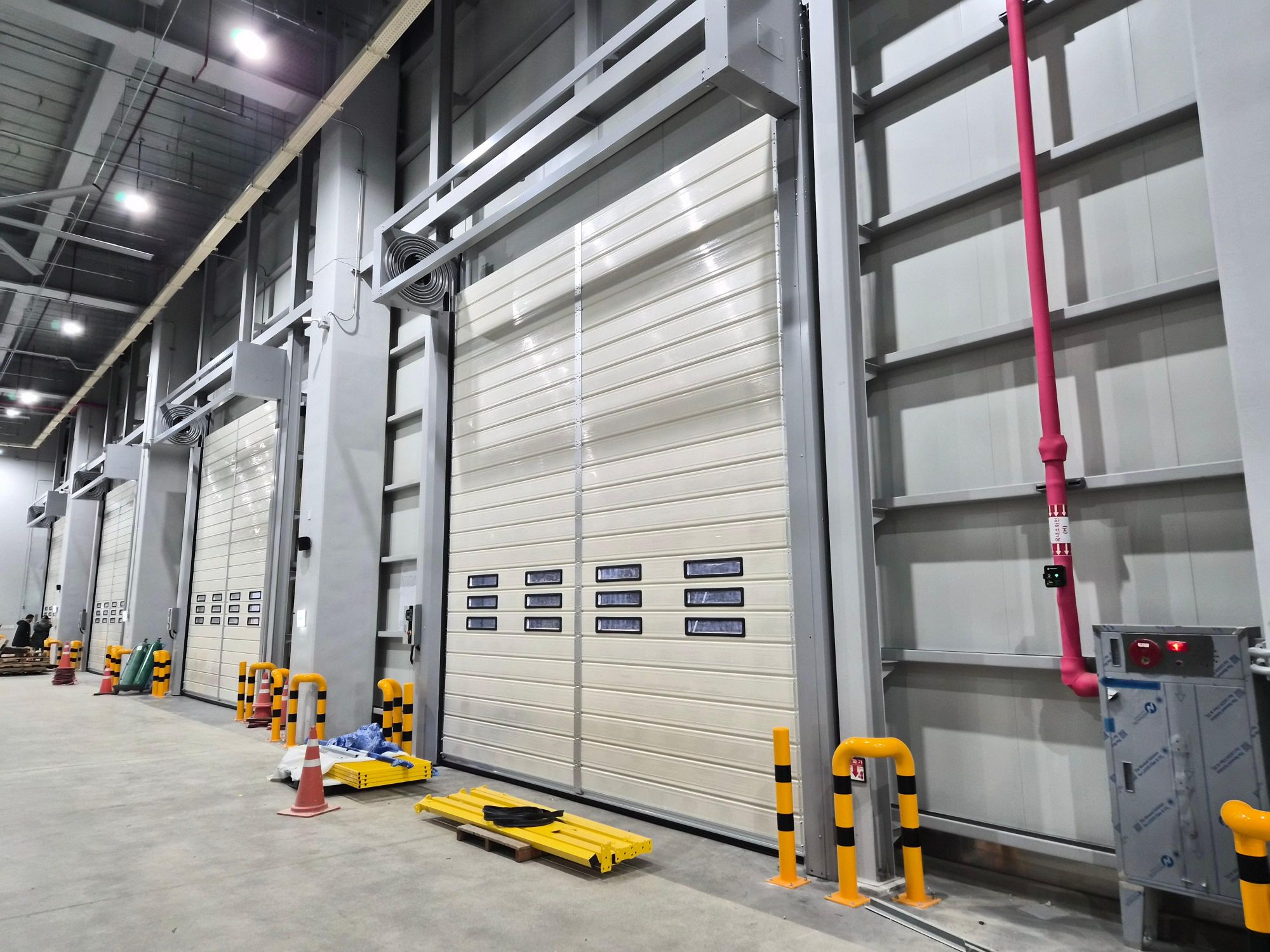
Behind every reliable high-speed door is a carefully orchestrated material strategy designed to absorb relentless motion without faltering. The curtains are rarely just PVC; they often integrate woven polyester cores that distribute tension across the entire surface, preventing the localized fatigue that leads to rips or delamination. Meanwhile, flexible polyurethane formulations in the edge channels create a shock-absorbing interface with the frame, reducing impact noise and preserving the alignment of the guides even after millions of opening cycles.
Beyond the curtain, the drive engineering plays an equally critical role. Instead of traditional chain-and-sprocket systems that wear out under continuous reversing, many rapid doors now employ direct-drive motors with helical gears cut from hardened, precision-ground steel. These components resist the pitting and brinelling that plague softer alloys, maintaining crisp acceleration and deceleration profiles year after year. Lubricant retention coatings on the bearing surfaces further extend service intervals, keeping maintenance crews away and throughput high.
Thermal stability and chemical resistance are often overlooked chapters in the durability story. In cold storage applications, curtains infused with low-temperature plasticizers remain pliable down to -40°F, avoiding the brittle fractures that would otherwise appear at the fold lines. For washdown environments, specialized coating technologies bond a molecular barrier to the fabric, repelling aggressive cleaning agents while allowing the material to flex freely. These invisible material choices ensure the door’s cycle life matches the operational tempo of the facility, not the other way around.
Seamless Integration: Tailoring High-Speed Doors to Your Facility
Every facility has its own rhythm, and a high-speed door shouldn’t disrupt it. The real measure of seamless integration lies in how effortlessly the door adapts to your existing architecture, workflows, and safety protocols. It’s not about forcing a one-size-fits-all solution, but about customizing track systems, activation methods, and panel materials so the door becomes a natural extension of your operation. When done right, you hardly notice it’s there—except in the data showing improved throughput and climate control.
Tailoring starts with the subtle details: the placement of sensors that sync perfectly with your forklift fleet, the curtain flexibility that matches your traffic patterns, or the motor speed tuned to the exact clearance heights you need. This level of personalization means no two installations look exactly alike, because no two facilities operate the same way. The goal is to craft an opening solution that feels intuitive, almost as if it had always been part of the building’s blueprint.
Ultimately, tailoring goes beyond physical fit. It encompasses control integration with your BMS or automated systems, enabling predictive adjustments based on shifts, seasonal demands, or even real-time logistics data. This transforms a simple barrier into a responsive, intelligent component that aligns with your operational vision—without adding complexity for your team.
Energy Without Leakage: The Hidden Savings of Modern Door Technology
Most people never think about their doors as energy drains, but they can be one of the biggest culprits in a home's thermal envelope. Even a tiny gap around the perimeter lets conditioned air slip out while pulling outdoor air in, forcing heating and cooling systems to work overtime. Modern door designs tackle this with precision engineering—triple-seal gaskets, thermally broken frames, and foam-filled cores that act like a thermos for your living space.
The real magic lies in materials that weren’t mainstream a decade ago. Fiberglass and composite doors now rival wood in aesthetics but far surpass it in insulation value, thanks to closed-cell polyurethane cores that don’t warp or lose R-value over time. Adjustable sills with magnetic compression seals create an airtight lock when the door closes, virtually eliminating the invisible drafts that make a room feel chilly despite the thermostat reading.
What’s often overlooked is how these improvements change energy consumption patterns. Homes with tight-door retrofits regularly see a 5–10% drop in annual heating and cooling bills—sometimes more in extreme climates. Beyond the numbers, there’s a comfort payoff: fewer cold spots near entryways, less dust infiltration, and a noticeable hush from outdoor noise. It’s not just about saving money; it’s about reclaiming the calm consistency your home should have had all along.
Safety in Motion: How High-Speed Doors Prevent Workplace Incidents
Routine movement through busy facilities often leads to split-second risks—forklifts crossing thresholds, personnel in blind spots, or sudden air pressure changes. High-speed doors address these everyday hazards not by merely reacting, but by anticipating them. Their rapid cycle times reduce the window of exposure, leaving far less room for a collision or an unexpected draft. The door opens only when needed, and closes immediately after, restoring the protective barrier without delay.
Beyond mechanical speed, these doors incorporate sensors that map the immediate environment. Light curtains, presence detectors, and activation loops work together to hold or reverse movement the moment an object—or a person—enters the path. This layered sensing creates a safety zone where the door behaves less like a machine and more like an aware participant in the workflow. The result is a dramatic drop in near-miss events and physical contact incidents.
The protection also extends to controlling the workspace itself. By sealing off areas in seconds, high-speed doors stabilize temperature, isolate noise, and contain dust or fumes. Workers are shielded from cross-traffic contaminants and harsh conditions without having to manually operate heavy barriers. In settings where hygiene or climate matter, this rapid isolation quietly prevents long-term health risks that might otherwise go unnoticed until they become a problem.
Field-Ready: Real Environments That Demand Rugged Rapid Doors
Not every door is built to handle the relentless pace of heavy industry. In places where forklifts zoom past every few seconds, temperature swings are extreme, and hygiene standards leave no room for error, only purpose-built rugged rapid doors can keep up. Their reinforced curtains, robust drive systems, and impact-resistant frames are engineered to absorb daily punishment without buckling, warping, or slowing down.
Take food processing plants, for example. Washdown routines mean doors face high-pressure water, harsh chemicals, and constant moisture—all while needing to maintain airtight seals to prevent contamination. A standard door would quickly corrode or delaminate. Rugged rapid doors, with stainless-steel hardware and seamless, cleanable surfaces, shrug off these conditions while still opening and closing in seconds to keep production flowing. Similarly, busy logistics centers rely on them to speed up traffic and resist inevitable collisions; built-in breakaway features let the door curtain pop out on impact and reset instantly, minimizing downtime.
Other demanding sites include pharmaceutical cleanrooms, cold storage facilities, and automotive assembly lines, where even a slight delay or seal failure can disrupt processes or compromise product quality. In these settings, rugged rapid doors do more than separate spaces—they actively protect controlled environments, conserve energy, and support constant movement. The real-world demand is clear: doors that are just “tough” aren’t enough; they must be fast, safe, and maintainable in the harshest of daily operations.
FAQ
Our doors are built with a focus on rapid cycle times and long-term durability, using reinforced guides and brushless motors that keep operations smooth and quiet even in high-traffic areas. Instead of just selling a product, we engineer each door to match the exact speed, size, and safety requirements of the facility where it will run every day.
It starts with a detailed site survey and load analysis, then we custom-cut the curtain material—usually a tough PVC blend—and assemble the drive unit with a direct-drive motor to minimize wear. Every door goes through a run-in test at full speed before shipping, so we catch any alignment or balance issues early.
They thrive in cold storage, cleanrooms, food processing, and busy logistics hubs. We offer variants with full stainless steel hardware for washdown areas, insulated curtains for temperature control, and high-wind bracing for exterior bays that face strong gusts.
We integrate light curtains and pressure-sensitive bottom edges as standard, not add-ons, and the control panels log every cycle to flag unusual resistance. Maintenance teams get data on peak usage times and wear trends, so proactive service replaces minor parts before a breakdown happens.
Every door comes with a 24-month comprehensive warranty, but more importantly, we assign a regional technician for on-site commissioning and training. Remote diagnostics via the controller let us troubleshoot most issues within the same shift, and spare parts are stocked locally in three distribution centers worldwide.
Absolutely. We’ve built doors up to 12 meters wide for aerospace hangars and compact models for conveyor pass-throughs. Customers can pick curtain transparency, color, and even brand their logo on the slats. If the opening shape is non-standard, our engineering team will design a subframe that fits without compromising the seal.
Conclusion
Modern industry demands more than just speed from its access points—it requires a seamless fusion of durability, energy efficiency, and intelligent design. At our high-speed door factory, every rapid door is crafted not merely as a fast opening but as a vital component of production protection. The materials are selected for relentless cycling, with reinforced fabrics, flexible yet tough curtain systems, and corrosion-resistant guides that withstand thousands of operations daily. Behind the swift motion lies meticulous material science, ensuring that each door maintains peak performance in harsh conditions, from refrigerated warehouses to heavy-traffic manufacturing bays. These doors don't just open and close quickly; they act as barriers against contaminants, temperature loss, and pressure imbalances, all while integrating smoothly with existing facility layouts through customizable dimensions, activation methods, and control interfaces.
Beyond the mechanics, the hidden value becomes apparent in energy savings and workplace safety. By minimizing air leakage during high-cycle operations, these rapid doors drastically cut heating and cooling costs, often paying for themselves over time. Safety is engineered into every movement, with advanced sensor systems that detect obstacles and prevent incidents before they occur, protecting both personnel and equipment. In the field, real environments prove the resilience of our doors—whether facing dusty construction sites, washdown areas in food processing, or the constant rush of logistics centers. This isn't just manufacturing; it's about delivering field-ready solutions that uphold the rhythm of modern industry without compromise.
Contact Us
Contact Person: Cyril He
Email: [email protected]
Tel/WhatsApp: 8613969697307
Website: https://cqyqgd.en.alibaba.com/