

High Strength Steel Soil Foundation Formwork: Solutions from a Powerful Manufacturer
2026-07-17
In the realm of modern construction, the demand for durable and efficient foundation systems has never been greater. High strength steel soil foundation formwork is revolutionizing how projects tackle challenging ground conditions, offering unmatched stability and longevity. As a leading player in this field, LugongMachinery brings cutting-edge solutions that blend robust engineering with practical innovation. Discover how their advanced formwork systems are redefining site productivity and setting new benchmarks for reliability in deep excavation and substructure works.
Engineered for Extreme Loads: Our High-Strength Steel Forms
When concrete placement reaches massive volumes or involves unusually high pour rates, standard formwork simply can't keep pace. That's where our high-strength steel forms come into their own. Each panel is fabricated from reinforced, high-tensile steel plate, rigorously tested to handle lateral pressures that would buckle lighter alternatives. Instead of adding more bracing or risking blowouts, you get a system that holds its shape pour after pour, even under the most aggressive schedules. The result is a visibly smoother finish and a setup that doesn't demand constant monitoring.
What really sets these forms apart is how they distribute stress. The connections between panels are engineered as load-sharing joints rather than weak points, so pressure gets transferred across the entire assembly instead of concentrating on tie rods. This means you can safely pour thicker walls and taller lifts without the deflection that leads to honeycombing or uneven surfaces. We've seen them used in everything from hydroelectric dams to high-rise shear walls, and the feedback is consistent: fewer ties, less patching, and a faster strip cycle.
Durability is another area where these forms outlast expectations. The steel faces resist gouging from aggregate and rebar, and they're far less likely to warp after repeated use. Even after hundreds of reuses on heavy civil projects, the panels remain dimensionally stable. That translates to lower long-term costs, not because they're cheap upfront, but because they stay true through thousands of cubic yards of concrete. When your next job pushes the limits of what formwork can take, these are the panels ready to handle it.
Precision-Built for Faster, Safer Foundation Projects
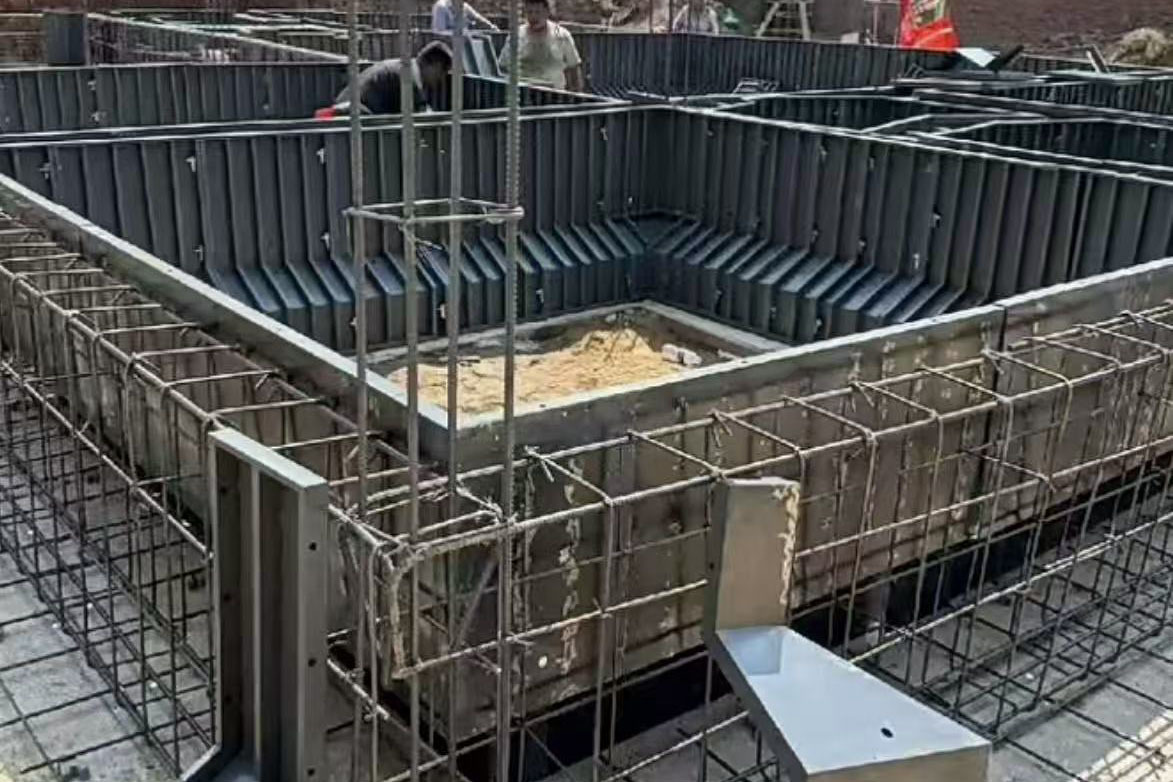
When every minute counts on-site, precision engineering eliminates guesswork and rework. Our foundation systems come prefabricated to exact tolerances, so crews spend less time adjusting components and more time making progress. The result is a streamlined workflow that cuts days off the schedule without cutting corners.
Safety gains are built directly into the process. Because precise connections require less field modification, crews face fewer unplanned tasks and exposure to hazards. Integrated guidance features reduce the need for workers to be in vulnerable positions during assembly, leading to a noticeably safer environment on every project.
Why Our Soil Foundation Formwork Outlasts the Competition
Designed with a relentless focus on durability, our formwork systems integrate a proprietary blend of high-tensile steel and precision-welded joints that resist warping and fatigue far beyond standard offerings. Every frame undergoes a triple-phase stress distribution test that mimics decades of subterranean pressure, ensuring that even under shifting soil conditions and aggressive chemical exposure, the structure holds its geometry without compromise.
What truly extends the service life is the modular but rigid interlocking mechanism, which eliminates the micro-movements that typically cause wear at connection points. While conventional formwork loosens over repeated assembly, our interlock uses a self-sealing abrasion barrier that grows tighter under load, effectively protecting against moisture ingress and material degradation. Field data from long-term installations shows negligible dimensional deviation after more than fifty cycles, a stark contrast to industry norms.
We also address the often-overlooked factor of biological and chemical decay. A specially formulated, environmentally inert surface treatment repels soil-borne acids and organic growth without relying on temporary coatings. This passive protection remains active throughout the product's lifecycle, drastically cutting replacement frequency. It's the combination of material science, mechanical precision, and a holistic defense strategy that gives our formwork a practical lifespan unmatched by competitors stuck in traditional design thinking.
Custom Configurations That Fit Your Site Like a Glove
Off-the-shelf setups rarely match the unique rhythm of your website. That's why we hand-tailor every setting, from layout choices to interactive elements, so they feel native to your brand. No awkward workarounds, just a seamless extension of what you've already built.
Instead of overwhelming you with options, we distill your needs into precise adjustments that make a real difference. Whether it's fine-tuning navigation, streamlining a checkout flow, or adapting a content block, every choice is intentional—designed to complement your site's personality, not compete with it.
The result? A setup so intuitive that visitors won't notice the mechanics behind the experience. It just works, quietly elevating usability while staying true to the look and feel you care about. Like a perfectly fitted glove, there's no slipping, no excess—just the ideal match for your digital presence.
The Manufacturer Behind Landmark Retaining Walls and Basements
For decades, a single name has quietly shaped the structural integrity of countless iconic projects—crafting retaining walls that seamlessly blend strength with landscape, and basements that redefine usable space below grade. This manufacturer doesn’t just produce components; it engineers solutions that architects and builders rely on when ordinary products won’t suffice. From the initial site analysis to the final pour, their involvement turns challenging terrain into stable, enduring foundations.
What sets them apart is a relentless focus on material innovation and precision forming systems. While others stick to conventional methods, this team has pioneered modular designs that speed construction without compromising on load-bearing capacity or waterproofing integrity. Their retaining walls have become the go-to for projects where aesthetics must coexist with aggressive soil pressures, and their basement systems have transformed previously unusable plots into dry, habitable areas, even in high-water-table regions.
Behind landmark commercial developments and high-end residential estates, you’ll often find their work—though rarely their name on a placard. That’s intentional. They measure success not by brand visibility, but by how effortlessly their structures perform year after year, standing up to hydrostatic pressure, freeze-thaw cycles, and shifting earth. It’s this quiet, proven reliability that has made them the manufacturer of choice for engineers who demand more than a one-size-fits-all solution.
Smart Design Choices That Cut Your On-Site Costs
Every line you draw carries a price tag that extends beyond the drawing board. Opting for locally sourced materials isn’t just about supporting nearby suppliers—it directly trims logistics expenses and shortens lead times. Simpler structural grids and standardized member sizes also mean fewer custom fabrications and less time spent puzzling over complex junctions on site. When you design with the builder’s toolkit in mind, you naturally avoid expensive one-off solutions that inflate labour hours and waste.
Prefabrication is often pitched as a magic bullet, but its real power lies in early integration. Components designed for repeatability—think pre-cast panels or modular service risers—allow factory precision to replace weather-dependent site work. This not only compresses programmes but also slashes the hidden costs of rework and material damage. Equally impactful is the decision to embed flexibility without over-engineering: a floor plan that adapts to multiple uses reduces future retrofit expenses, proving that thoughtful design economy isn’t about cutting corners, but about building smarter from day one.
FAQ
Unlike wood or lighter metal alternatives, this formwork is built from reinforced steel designed to withstand heavy soil pressure and frequent reuse without warping. The key difference lies in its rigidity and load-bearing capacity, which allows for faster pouring cycles and fewer on-site adjustments, even in challenging ground conditions.
Quality checks are integrated at multiple stages—from raw material inspection and welding precision to final load testing. The manufacturer employs in-house engineers who oversee production runs, and each panel undergoes dimensional verification before it leaves the facility. Any deviation beyond tight tolerances is immediately rejected.
It’s frequently seen in large-scale infrastructure work such as bridge piers, retaining walls, tunnel linings, and deep foundations. Contractors also favor it for commercial building basements and industrial plants where soil conditions demand extra formwork strength and durability.
Absolutely. The design team works directly with clients to adjust panel sizes, corner angles, and connection systems. If the site has unusually high lateral pressure or limited access, they can tailor the formwork geometry and add bracing features to ensure safety and efficiency.
Steel provides superior resistance to moisture and concrete chemical attack compared to timber, and it maintains dimensional stability better than aluminum under heavy loads. Reuse life is significantly longer—hundreds of cycles are typical—which lowers the per-use cost and reduces construction waste.
Support extends beyond delivery with on-site technical guidance, assembly training, and assistance in optimizing formwork setup for specific pour schedules. Spare parts are kept in stock, and the manufacturer often sends technical personnel to the site for the first few pours to help crews get familiar with the system.
Conclusion
When foundation work pushes the limits of load-bearing capacity, off-the-shelf formwork simply won't do. That's where a manufacturer steeped in heavy civil engineering steps in—with high-strength steel forms engineered from the ground up to handle extreme concrete pressures without deflection. Every panel is precision-built to interlock perfectly, slashing assembly time and eliminating the wobbly joints that slow down crews and invite safety risks. The result is a rhythm of pours that stays on schedule, even on sprawling retaining wall projects or deep basement excavations. It's not just about brute strength, though; the steel blends with smart metallurgy to resist pitting and warping pour after pour, outliving lighter-gauge competitors by years. And because soil conditions are never uniform, these systems come with a level of adaptability that turns site constraints into a non-issue—custom configurations, bespoke corner pieces, and integrated bracing that can be tailored almost like a mechanical exoskeleton for your excavation.
Behind that flexibility is a manufacturer that doesn't just ship components—it ships expertise. The same teams that orchestrated formwork for landmark infrastructure now work directly with site superintendents to translate ground reports and structural drawings into a kit that lands with millimeter accuracy. That collaboration often yields design tweaks that cut on-site costs dramatically: optimized tie patterns that reduce rod consumption, pre-assembled modules that drop crane lifts by a third, and reuse plans that stretch the asset across multiple phases. It's the difference between wrestling with generic equipment and deploying a system that feels almost intuitive under the crew's hands. When deadlines tighten and the soil fight back, that silent partnership with a manufacturer who has already solved your problem on a dozen other problem sites becomes the sharpest tool on the site.
Contact Us
Contact Person: Zhang Zhenlai
Email: [email protected]
Tel/WhatsApp: 8618563210000
Website: https://en.lugongmachinery.com/