
Industrial HVLS Fans Customized Manufacturer: Tailored Airflow Solutions for Large Spaces
2026-06-25
In vast industrial facilities, standard fans rarely cut it. That's where VINDUSFAN steps in—crafting customized HVLS fans that transform stagnant air into precise, energy-efficient comfort. Whether you're cooling a cavernous warehouse or ventilating a busy factory floor, one-size-fits-all doesn't apply. Discover how tailored airflow solutions from VINDUSFAN redefine what's possible in large-space climate control, and why generic options simply can't compete.
Designing HVLS Fans Around Your Unique Space Requirements
Every building has its own architectural character and operational demands, and a one-size-fits-all fan simply can't deliver optimal comfort. The key lies in evaluating the interplay between blade diameter, mounting height, and the specific activities happening below. For areas with dense racking or low ceilings, a smaller high-volume unit with carefully directed airflow prevents turbulent pockets, while vast open atriums might benefit from massive airfoils that slowly churn a gentle column of air from floor to ceiling. It’s not about raw power—it's about sculpting the air to match the footprint and function of the space.
Beyond mere dimensions, structural and aesthetic considerations often dictate the final design. A facility with exposed beams or intricate lighting layouts may require custom mounting brackets or unconventional hub placements. Similarly, spaces where noise is a concern call for blade profiles and motor configurations that operate in near silence. By factoring in these constraints early, the fan becomes an integrated element of the environment rather than an add-on. The objective is always a balance where air movement feels natural and unintrusive, supporting the rhythm of the room without drawing attention to itself.
Adapting to unique conditions also means looking at how air enters and leaves the zone. Adjacent doorways, active ventilation systems, and thermal loads from machinery or sunlight create distinct microclimates. A thoughtfully positioned HVLS fan can counteract hot spots or redirect cooled air before it escapes, effectively amplifying the existing HVAC strategy. This level of customization demands a collaborative design process, where on-site observations and occupant feedback shape the final layout. When done right, the fan feels less like a machine and more like a seamless extension of the building’s own breath.
Engineering Precision Air Movement for Massive Industrial Environments
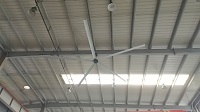
Moving air through spaces the size of aircraft hangars or massive production floors demands a different mindset entirely. Standard HVAC logic falls apart when ceiling heights soar past forty feet and thermal loads fluctuate by the minute. We're not just cooling or ventilating—we're choreographing currents across invisible gradients, balancing pressure zones that shift with every open bay door or fired-up production line.
That kind of precision leans heavily on custom aerodynamic modeling and a willingness to ditch generic spec sheets. It means tuning fan arrays for laminar flows where turbulence would wreck a process, or using stratification to our advantage rather than fighting it. In practice, this often involves weaving together high-volume, low-speed ceiling units with strategic wall-mounted recirculation paths, all governed by sensor grids that read air density, not just temperature.
The payoff shows up quietly: condensation doesn't cling to steel overhead, exhaust fumes hug their designated extraction routes, and the kilowatt-hours saved can reshape a plant's operating budget. For the people working there, it's the difference between a drafty cavern and a space where the air simply does what it should, shift after shift.
From Warehouses to Hangars: Adaptable Cooling for Any Large-Scale Setting
Cooling a warehouse filled with towering shelves is nothing like conditioning a hangar where a multimillion-dollar jet sits idle. The air volume, heat sources, and usage patterns differ wildly. Adaptable cooling solutions skip the rigid, one-size-fits-all model and instead lean on modular, configurable components—think portable chillers, ductless split systems, and high-velocity fans—that can be mixed and matched. In a distribution center, units might be arranged along packing lines to keep staff productive without blasting cold air across empty aisles. In an aircraft hangar, spot cooling preserves sensitive electronics while general airflow handles the rest. Flexibility is the core idea, not an afterthought.
The real strength of these systems emerges when the layout changes. A factory floor gets reconfigured for a new product line; a warehouse suddenly needs a climate-controlled section for perishable goods. With bolted-down traditional HVAC, that means expensive retrofits. Adaptable setups, on the other hand, can be repositioned or expanded in hours. Ductwork gets swapped for open-air throw from floor-mounted units; condenser arrays scale upward as heat loads increase. And because they operate in zones, you’re not paying to cool 80,000 square feet just to keep a small workshop comfortable. It’s a practical, cost-conscious approach that makes large-scale environments far more manageable.
Maintenance doesn’t have to become a logistical headache either. Many adaptable cooling designs favor accessible components and modular replacements, so a failed fan motor or coolant line doesn’t bring everything to a halt. Energy efficiency is built in through variable-speed compressors and smart controllers that respond to real-time conditions—not timers. Whether it’s a dusty logistics hub, a humidity-sensitive museum storage, or an open-bay repair facility, these systems prove that one intelligent framework can handle vastly different demands without sacrificing performance or blowing out operational budgets.
Beyond Standard Sizes: How Custom Blades and Motors Optimize Performance
Off-the-shelf components often force compromises. A motor that almost fits your envelope or a blade that nearly matches your desired thrust curve might work on paper, but real-world performance suffers in subtle yet critical ways. Custom blades and motors eliminate these mismatches by aligning every dimension, material property, and electrical characteristic with your specific application. The result isn’t just a collection of parts—it’s a cohesive system where each element complements the others, unlocking efficiencies you simply can’t achieve with standard catalogs.
When you tailor a blade’s airfoil, diameter, and pitch to your exact flow conditions, you stop wasting energy on turbulence or off-design operation. Similarly, a motor wound for your precise torque and speed requirements operates closer to its peak efficiency point, reducing heat buildup and extending service life. The synergy between a custom blade and motor means you’re no longer constrained by the typical trade-offs between size, power, and thermal limits. Instead, you get a solution that performs exactly as needed—without the excess weight, bulk, or electrical overhead that standardized options impose.
This approach also opens up design possibilities that standard components close off. Need an ultra-compact assembly that delivers high static pressure in a confined space? A shorter, wider blade paired with a high-torque, low-profile motor can make that possible. Working with high-temperature or corrosive environments? Custom material choices in both the blade and motor ensure reliability where general-purpose alternatives would fail. It’s this freedom to optimize every variable that turns an adequate design into an exceptional one, delivering performance that off-the-shelf parts simply can’t match.
Reducing Operational Costs Through Tailored Energy-Efficient Airflow
Facilities often waste a significant portion of their cooling energy by running ventilation systems at fixed, maximum levels—even when actual demand is low. Tailored energy-efficient airflow replaces this brute-force approach with a responsive strategy that adjusts air delivery to match real-time thermal loads. By analyzing the specific layout and heat sources of a space, the system supplies precisely the right volume of air to each zone, eliminating the blanket overcooling that drives up electricity bills without improving comfort or equipment protection.
The shift begins with a detailed assessment using tools like computational fluid dynamics and wireless sensor networks. These generate a heat map of the environment, revealing hotspots, air leaks, and flow bottlenecks that generic fan curves ignore. The resulting airflow plan optimizes fan speeds, damper positions, and even duct modifications to create low-pressure, high-impact paths. For example, rerouting conditioned air directly to server intake areas in a data center, or targeting machine line zones in a factory, minimizes the power drawn by fans—which often accounts for half of the cooling system’s energy use—while maintaining target temperatures more consistently.
The operational cost benefits extend well beyond the immediate drop in kilowatt-hours. Reducing fan speeds and cycling lowers wear on motors, belts, and bearings, cutting maintenance calls and extending equipment lifespan. In many retrofits, companies report a 25-40% reduction in cooling-related energy costs alongside fewer emergency repairs. Because the design is bespoke rather than a one-size-fits-all upgrade, it avoids the diminishing returns of standard variable-speed drives and keeps efficiency gains durable even as room layouts or workloads change.
Installation and Fine-Tuning: Ensuring Seamless Integration with Your Facility
Getting a new system up and running starts well before any hardware is unboxed. Our specialists spend time mapping out your facility’s workflow, noting everything from floor layouts to existing equipment interfaces. This early legwork prevents the headaches that come from trying to retrofit a solution into a space that wasn't properly assessed. The result is an installation that respects your operational rhythms, not one that forces you to adapt to the technology.
Fine-tuning is where the generic turns bespoke. Once the foundation is in place, the real work begins—adjusting sensor thresholds, calibrating response times, and tweaking control parameters until the system operates in harmony with your team’s daily demands. It’s a hands-on process that often involves your staff, because nobody knows the quirks of your facility like the people who work there every day. That collaboration catches subtle issues that a manual could never predict.
When done right, the integration feels almost invisible. There's no jarring transition, no period of clunky adjustment—just a tool that slips into your operations as if it’s always been there. This kind of seamless fit doesn’t happen by accident. It’s the product of patient, meticulous assembly and a refusal to walk away until everything clicks. That’s the difference between a system that merely functions and one that actually makes your job easier.
FAQ
Warehouses, manufacturing plants, gymnasiums, and any large open areas with high ceilings see immediate improvements in air circulation and comfort.
We assess ceiling height, obstructions, column spacing, and airflow needs, then adjust blade size, pitch, and motor placement to maximize coverage without dead zones.
Yes, by gently pushing warm air trapped at the ceiling back down to floor level, they reduce the load on heating systems by up to 30%.
Standard fans often leave gaps in airflow or create uncomfortable drafts. Custom engineering matches the fan’s performance curve exactly to your space for consistent, quiet operation.
Absolutely. We design around existing equipment, using compact motor housings and elongated drop tubes to keep blades safely below obstructions while maintaining performance.
Depending on complexity, most projects move from initial assessment to full operation within 6–8 weeks, including on-site measurements, fabrication, and professional mounting.
Maintenance is minimal—mostly periodic bolt checks and cleaning. Custom designs often include easier-access motor pods and sealed bearings to reduce long-term service needs.
Yes, we provide variable speed drives and control modules that connect seamlessly with most BMS, allowing automated scheduling and zone-based adjustments.
Conclusion
Every large space has its own airflow personality—ceiling heights, obstructions, occupancy patterns, and thermal loads all shape what effective air movement should look like. A truly customized HVLS fan isn't just a bigger version of an off-the-shelf model; it begins with a deep assessment of your facility's layout and operational rhythm. By analyzing factors like column spacing, overhead clearance, and work zones, our engineering team designs blade profiles, diameters, and mountings that fit seamlessly into your environment rather than forcing you to adapt around a stock product. Whether it's a distribution center with narrow aisles, a sports complex with tiered seating, or a hangar filled with sensitive equipment, the airflow pattern—gentle, broad, and precisely directed—is mapped to your unique footprint. This level of customization means every kilowatt of power moves air purposefully, eliminating dead zones and thermal stratification without disrupting day-to-day activities.
The real payoff goes beyond comfort. When blades, motor sizing, and control logic are tailored to the actual volume and use of a space, performance leaps while energy consumption drops. Custom airfoils and variable-speed drives let us fine-tune the balance between high-volume, low-speed movement and static pressure, so the fan works with your HVAC system rather than against it. In many cases, a purpose-built HVLS solution can slash cooling and heating costs by 20–30% simply by destratifying air and reducing reliance on packaged units. Installation is treated as an extension of the design phase—mounting solutions are engineered to match roof structures, seismic requirements, and existing utilities, minimizing downtime. Post-installation commissioning ensures that the fan integrates with building management systems and behaves exactly as modeled. The result isn't just a piece of equipment; it's a long-term climate control strategy that adapts as your facility evolves.
Contact Us
Contact Person: Michael Danielsson
Email: [email protected]
Tel/WhatsApp: +1 951 565 7769
Website: https://www.vindusfans.com