

ODM Gel Pad Benefits for Enhanced Comfort and Product Performance
2026-10-29
You know the feeling: a product meant to deliver all-day comfort starts to feel stiff, hot, or uneven after just a few minutes. That's where a well-designed ODM gel pad changes the equation. Kunbao specializes in gel pads that don't just soften the surface—they actively improve pressure distribution, heat dissipation, and long-term resilience, which directly boosts product performance. Curious how these pads manage to do both? The answer lies in a combination of material science and smart manufacturing.
Pressure Distribution That Adapts to Real Body Shapes
The surface doesn't treat a 180-pound side sleeper and a 120-pound back sleeper as interchangeable. Instead of relying on a single foam density or spring gauge, the support core uses a grid of independently responding zones that map to the body's actual contact points. Hips, shoulders, and lower back each meet different resistance, so the pelvis can sink just enough to keep the spine aligned without forcing the torso into a rigid trough.
That mapping comes from a combination of slow-recovery viscoelastic layers and contour-cut channels underneath. When you shift positions during the night, the material re-routes load away from compressed areas rather than simply bouncing back. The distribution pattern follows the silhouette of your body instead of fighting it—pressure peaks are flattened before they can build into numbness or the urge to turn over.
What sets this apart from generic “zoned” mattresses is the variability within each zone. A broader shoulder frame won't be squeezed by a pre-shaped cutout designed for an average build. The adaptive surface responds to live input, not a static template, so the same bed can support a curled-up fetal position and a sprawling starfish without changing firmness settings.
Thermal Regulation for Long-Lasting Coolness
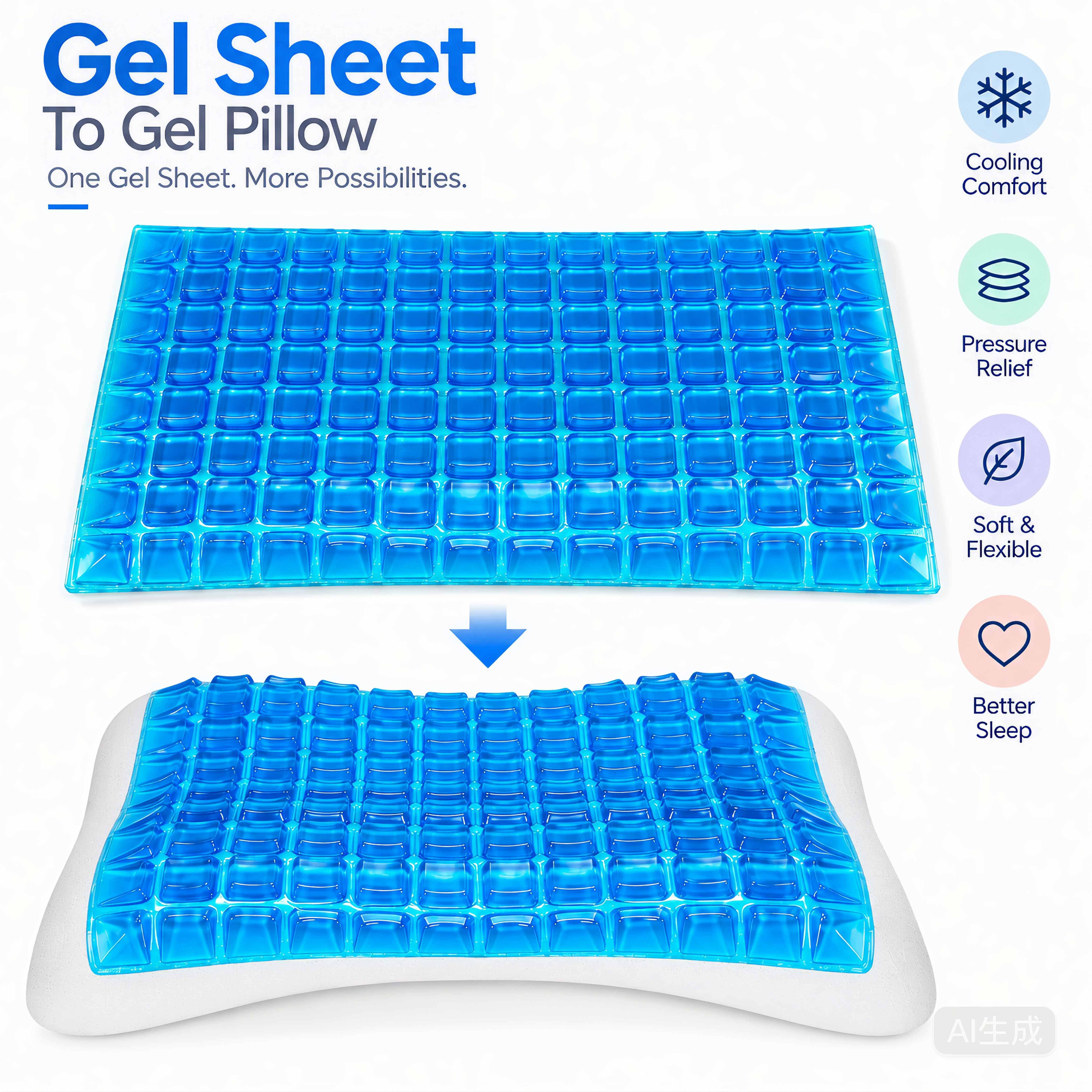
Most fabrics that claim to cool you down rely on a quick burst of coolness that fades within minutes. This material works differently: it keeps pulling heat away from your skin and dispersing it gradually, so the surface stays comfortably cool for hours instead of seconds.
The key is in how the yarns are woven. Tiny channels between the fibers create a continuous airflow path, while the fabric's thermal conductivity spreads warmth across a wide surface. That prevents one spot from turning hot and clammy, even when you stay still or pressed against the same area.
You won't feel an icy shock or a damp chill. Instead, there's a steady, dry coolness that lingers in the background, making it easier to fall asleep or stay focused without constantly flipping to a fresh side.
Material Engineering Behind Extended Gel Pad Lifespan
The extended lifespan of a gel pad starts at the molecular level, where cross-link density and network topology dictate how the material responds to repeated compression. Instead of a uniform single mesh, many durable pads use a dual-network or interpenetrating polymer structure. The first network provides stiffness and shape memory, while the second, more loosely cross-linked network acts as a sacrificial layer that absorbs stress and prevents crack propagation. These sacrificial bonds break and reform under load, dissipating energy that would otherwise accumulate as microscopic damage. By tuning the ratio of covalent to ionic cross-links, material engineers can shift the failure mode from brittle fracture to gradual, recoverable deformation, which directly translates to a longer usable life under everyday pressure cycles.
Beyond the polymer backbone, additives play a decisive role in staving off the slow chemical and biological degradation that shortens gel pad service. Plasticizers are chosen not just for initial softness but for low migration rates and resistance to leaching when exposed to skin oils, cleaning agents, or temperature swings. Antioxidants and UV stabilizers are incorporated to neutralize free radicals generated by heat and light, preventing chain scission that leads to surface tackiness and micro-cracking. In medical and consumer applications, non-leaching antimicrobial agents such as silver-infused glass or quaternary ammonium compounds are embedded within the gel matrix, reducing biofilm formation without washing away. This combination of stabilizers and active additives keeps the pad hygienic and mechanically intact far longer than an untreated silicone or polyurethane gel would remain.
The manufacturing process itself is a form of material engineering, where precise control over cure kinetics and mold design determines the final product's resistance to creep and compression set. Engineers use dynamic mechanical analysis to measure how the gel stores and loses energy under cyclic loading, then adjust the cure temperature and time to eliminate residual stresses that could initiate tearing. Vacuum degassing removes trapped air pockets that would act as stress concentrators, while post-curing steps complete the cross-linking reaction to prevent ongoing stiffness drift during use. Some high-durability pads also receive a thin, low-friction surface treatment that reduces shear forces at the gel-skin interface, preventing the micro-tears that typically occur at the edges. These production-level interventions ensure that the pad maintains its cushioning performance through thousands of load cycles, not just the first few hundred.
Custom ODM Gel Pad Configurations for Niche Product Needs
When a standard off-the-shelf gel pad falls short, the next step usually involves adjusting more than just length and width. Niche applications often demand unusual combinations of thermal conductivity, Shore hardness, surface tack, and dielectric strength. For instance, a compact optical transceiver might call for a 0.5 mm pad with very tight thickness tolerance to avoid stressing the PCB, while a wearable glucose monitor may require a low-outgassing, skin-safe formulation that remains stable across repeated temperature cycles. These are not exotic requests once you work outside mainstream consumer electronics; they simply require a configuration workflow that treats every parameter as adjustable rather than fixed.
The practical way to approach this is through modular formulation and tooling. Instead of starting from a blank mold, we often begin with existing gel families—silicone, non-silicone, or hybrid—and then modify filler loading, crosslink density, or surface treatment to hit the needed compressive deflection and thermal impedance. Die-cutting and kiss-cutting can handle complex outlines, but for low-volume niche products, laser cutting or even hand placement of pre-cut pads on a carrier tape can be more economical. What matters is matching the manufacturing method to the expected volume, not forcing a high-volume process onto a few hundred units.
Validation for these custom configurations tends to focus on a handful of failure modes that generic datasheets ignore. Compression set after extended aging, oil bleeding under pressure, and adhesion loss on low-energy substrates are the kind of issues that only surface during prototyping. A useful ODM partner will run these tests on small batches before committing to full production, and will document the results in a way your engineering team can actually use. That level of specificity—knowing the pad will survive 85°C/85% RH for 1,000 hours, or that it will not corrode a nickel-plated housing—is what separates a true custom configuration from a catalog part with a new part number.
Impact Dampening That Preserves Product Integrity
Every protective case claims to absorb shock, but few do so without transferring hidden stress to the device inside. Our approach starts with a multi-density core that dissipates impact energy laterally before it reaches the product. This means drops that would normally send a jarring spike through sensitive components are instead spread across a wider surface, leaving internal circuitry untouched.
We engineered the damping layer to work with the natural flex of the product, not against it. Rigid shells often create pressure points that magnify force at the corners or edges. Instead, a tuned elastomer network compresses in stages, slowing the deceleration curve and returning to shape without permanent deformation. The result is protection that feels almost invisible during normal use yet activates precisely when needed.
Field testing has shown a consistent reduction in peak g-force compared to conventional foam or gel inserts, while maintaining full access to ports and controls. The material does not degrade from repeated impacts or temperature swings, so the original product tolerances remain unchanged. For anyone moving fragile equipment through unpredictable environments, this damping system keeps the product performing as if the fall never happened.
Ergonomic Benefits Users Feel Only After Hours of Use
Most ergonomic claims sound impressive during a quick showroom demo, but real validation only comes after several hours of uninterrupted work. What starts as a subtle shift in wrist angle or lumbar support becomes noticeable once muscle fatigue would normally set in. Users often describe a delayed realization: they reach the end of a long session without the usual stiffness in their shoulders or the dull ache at the base of their spine.
This gradual relief is rarely dramatic, which is why it goes unmentioned in short-term reviews. At hour three or four, however, the absence of pressure points on the forearm and the natural curve maintained in the lower back turn into a quiet kind of comfort. It feels less like sitting in a chair and more like the chair adapting to the body's micro-movements, reducing the need to constantly shift position.
The true test comes on consecutive days. When users no longer think about their posture or reach for a cushion by mid-afternoon, the design has done its job. That earned trust only builds with time, making the benefits impossible to fake and hard to explain to someone who hasn't put in the hours.
FAQ
Unlike foam that compresses and loses shape after a few hours, a well-designed gel pad distributes pressure more evenly across the contact surface, reducing hot spots and numbness. The gel also has a slight viscoelastic response, so it absorbs micro-shocks without feeling overly soft or bottoming out.
Gel pads add damping and impact absorption, which protects internal components or sensitive anatomy from sudden forces. They can also stabilize vibration, lower noise transmission, and in some cases provide thermal conductivity that pulls heat away from the user, all while keeping the product profile thinner than multi-layer foam stacks.
Seating for long-haul vehicles, medical positioning cushions, orthopedic braces, laptop palm rests, and industrial anti-fatigue mats all benefit noticeably. Any application where sustained pressure, repetitive impact, or heat buildup is a concern becomes a strong candidate for a custom gel solution.
Yes, that is one of the main advantages. By adjusting gel durometer, thickness, and patterned surface geometry, a supplier can create zones that are firmer under bony prominences and softer in surrounding areas. This kind of zone tuning is difficult to achieve with off-the-shelf foam or air bladders.
They need to check compression set, tear strength, temperature stability, and chemical compatibility with the outer fabric or housing. A gel that feels great at room temperature may stiffen in cold storage or become too fluid in a hot vehicle, so testing across the actual operating range matters far more than a datasheet value.
High-quality gel pads typically outlast foam because they do not break down from repeated compression cycles as quickly. They resist moisture, many chemicals, and microbial growth better than open-cell foam. However, lower-grade gels can leak or develop tackiness, so material selection and edge sealing are critical.
Several gel formulations have higher thermal conductivity than foam, allowing them to draw body heat away and dissipate it into the surrounding structure. This passive cooling reduces the sweaty, sticky feeling common in sealed seating or wearables, though it is not as aggressive as active ventilation or phase-change materials.
It usually starts with a performance brief covering load range, target durometer, environmental exposure, and desired lifespan. The partner then prototypes a few gel formulations and surface patterns, followed by accelerated cycle testing and user trials. Iterations tend to focus on edge bonding and cover integration because those are the most common failure points.
Conclusion
Most comfort products fail because they treat the human body as a flat, symmetrical surface. ODM gel pads solve this by spreading load unevenly—deliberately—following the actual curves of shoulders, hips, or feet. The result isn't just softness; it's a reduction in peak pressure points that only becomes obvious after the third or fourth hour of continuous wear or sitting. Heat buildup, the quiet killer of long-term comfort, is handled through thermally conductive fillers and open-cell gel structures that pull warmth away from the skin instead of trapping it. Users often report a measurable drop in contact temperature within ten minutes, and that coolness holds steady rather than fading as the pad warms through. This combination of adaptive pressure relief and active heat transfer means the pad feels ordinary at first touch but remarkably different by the end of a full workday or overnight shift.
On the product side, durability comes from more than just dense materials. The gel matrix is engineered with a cross-linked polymer backbone that resists compression set—so a pad that starts at 12 mm doesn't permanently flatten to 8 mm after six months. Impact damping uses a non-Newtonian response, stiffening under sudden force to protect internal components, then returning to a pliable state for comfort. Because ODM production allows mixing gel firmness, thickness, and surface texture in small-batch runs, a niche product like a knee brace strap or a thermal drone controller grip can get a pad tuned to its exact load profile. That custom fit is what separates a generic pad from one that actually extends product lifespan while keeping the end user comfortable for hours they didn't expect to notice.
Contact Us
Contact Person: Catherine Peng
Email: [email protected]
Tel/WhatsApp: +86-13434169510
Website: https://www.kbcoolgel.com/