
ODM Ski Socks: Custom Manufacturing Solutions for Your Brand
2026-08-15
Skiers know that the right socks can make or break a day on the slopes. Yet for brands, offering ski socks that truly stand out means moving beyond generic designs. That's where ODM ski socks come in—custom manufacturing solutions that let you control everything from fiber blends to compression zones. At Mingjun, we turn those possibilities into production-ready products, helping your brand deliver exactly what skiers need. Ready to see how custom ski socks can give your line a competitive edge? Keep reading.
The Anatomy of a Ski Sock That Actually Performs
Most skiers never think twice about their socks until halfway down a long run when a fold starts digging into their shin or a toe seam rubs raw. A ski sock that actually performs isn't just a thicker version of your everyday pair — it's engineered from the inside out. The first thing to look at is the material blend. Merino wool is the gold standard because it regulates temperature and wicks moisture without getting crusty after multiple days on the hill. You'll often see it blended with nylon for durability and a touch of elastane so the sock stays put instead of slouching into your boot.
Next, pay attention to the cushioning zones. Unlike a generic hiking sock, a proper ski sock places extra padding only where you actually need it — typically over the shin, under the heel, and along the Achilles. That targeted cushioning reduces pressure points from stiff ski boots without adding bulk that would make your boots feel tighter. The calf and instep should have a ribbed or compression-like knit to support circulation and prevent the sock from bunching when you flex forward. A flat, hand-linked toe seam is non-negotiable; any raised stitching there will announce itself by lunchtime.
Finally, height and fit matter more than most people realize. The sock should rise well above the top of your boot, with no bare skin exposed to rub against the liner. A proper ski sock has a distinct left and right shape, mirroring the anatomy of each foot rather than being a one-size-fits-both tube. If you've ever had a sock that twisted around your foot inside your boot, you know why that matters. Get the anatomy right, and you won't think about your socks again until it's time to peel them off in the lodge.
Yarn Blends That Keep Feet Warm Without the Bulk
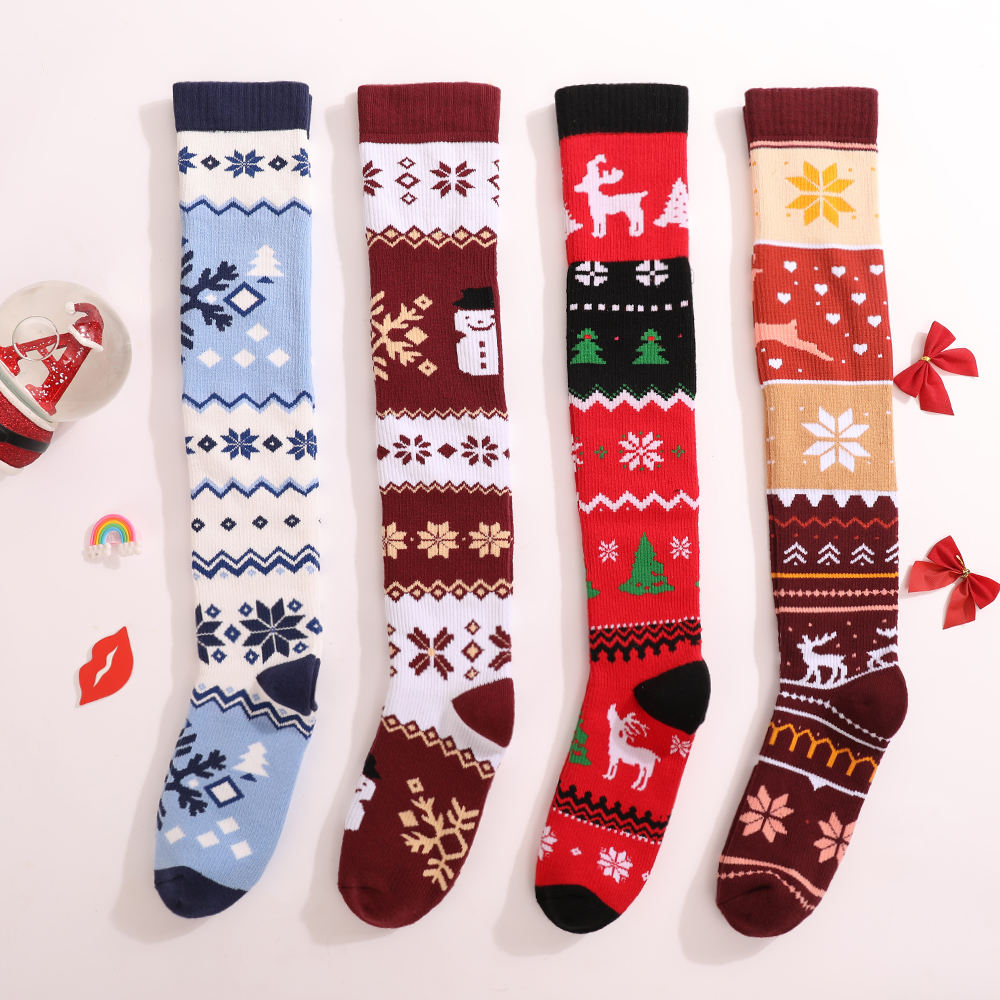
There's a quiet frustration in pulling on thick socks that make your boots feel two sizes too small, all because someone assumed warmth must come with extra weight. The best yarn blends for cold feet flip that logic entirely. By combining fibers with naturally hollow cores—think alpaca or certain wools—with lightweight synthetics like nylon or acrylic, you trap more air per gram than a heavier single-fiber yarn ever could. That air, not the fiber itself, is what holds heat close to your skin.
A merino-bamboo blend does this especially well. Merino gives you that soft, itch-free warmth and manages moisture without turning clammy, while bamboo adds a silky, breathable structure that prevents the sock from feeling dense or stiff. The result is a sock that skims your foot rather than smothering it. For even colder days, look for blends with a touch of yak or silk—they add surprising warmth for their weight, and they wear well against the skin without the bulk of a traditional wool boot sock.
What makes these blends work isn't just the materials but how they're spun. A loosely twisted, airy yarn will insulate better than a tightly packed one because it creates more tiny pockets for warmth. So when you shop, give the yarn a gentle squeeze. If it springs back with a light, almost spongy feel, you've found a blend that will keep your toes toasty without ever making you feel like you're walking around in a pair of pillows.
Custom Fit and Compression: Why One Size Never Fits All
Bodies are rarely symmetrical, and neither are the ways they swell, shift, or carry pressure. A sock or sleeve labeled 'medium' might squeeze one calf perfectly while sliding down the other, or pinch behind the knee after an hour of wear. Compression that's too loose fails to support circulation; too tight, and it turns a recovery tool into a tourniquet. The result is that many people abandon compression entirely, blaming the concept rather than the generic sizing.
Custom fit changes the conversation. By measuring at multiple points—ankle, calf, thigh, sometimes even the arch—manufacturers can build a gradient of pressure that mirrors your actual limb. This isn't just about comfort; it's about effectiveness. A properly fitted compression garment holds its position, delivers consistent pressure where it's needed, and avoids the dreaded bunching behind the knee or slipping at the waist. For conditions like lymphedema, venous insufficiency, or post-surgical recovery, those millimeters of difference translate into measurable outcomes.
The emotional payoff matters too. When a garment finally fits without constant adjustment, you stop thinking about it. You can walk, run, or stand through a work shift without the nagging awareness of fabric fighting your body. That's the real reason custom fit is worth the extra time and cost—not because it's a luxury, but because it lets compression do its silent, steady job while you get on with your day.
From Sketch to Sample: How We Turn Ideas into Wearable Prototypes
A sketch on our table rarely looks like a finished garment. It's more like a messy map—crooked seams, arrows pointing to where a pocket might live, a scribbled note about how the fabric should fall. That looseness is intentional. We don't want the drawing to lock the idea down too early. Instead, it gets pinned to the wall next to fabric swatches and body measurements, and then we start cutting.
Moving from paper to a wearable mock-up usually involves old bedsheets, a few safety pins, and a lot of trial and error. The first version is almost never right. We'll sew a sleeve, try it on, feel where it pulls across the shoulder, then rip the seam and adjust. Sometimes a whole silhouette gets abandoned after an afternoon of walking around the studio in it. Those failures matter more than the sketches because they tell us what actually works on a moving body.
By the time a sample is ready, it still carries small traces of that process—a hand-stitched hem, a slightly uneven pleat, or a mark where a pin left a hole. We leave those in on purpose. The goal isn't a polished presentation piece; it's a prototype that proves an idea can survive outside a notebook and become something someone can put on.
Scaling Production Without Sacrificing Stitch Quality
Growing order volumes often tempt workshops to push machine speeds and shorten stitch lengths, but that's where quality quietly erodes. Instead, the real lever is standardizing tension settings and thread paths across every head before a single unit ships. When each station runs the same calibrated baseline, a 30% jump in output doesn't automatically translate into skipped stitches or uneven satin borders.
Another overlooked factor is operator rhythm. Rather than asking sewers to simply "work faster," we break each run into preset batching sequences—hooping multiples, staging thread changes, and pre-trimming backing. This keeps the needle engaged without forcing abrupt accelerations that cause puckering on dense fills. Pair that with a mid-run quality checkpoint every 50 pieces, and defects get caught before they multiply across a shift.
Finally, don't let thread and backing choices become afterthoughts under volume pressure. Heavier production schedules expose weak materials quickly; switching to a low-lint polyester core and a medium-weight cutaway stabilizer prevents most stitch distortion without slowing the line. Scaling then becomes a matter of adding shifts and heads, not accepting lower standards as inevitable.
Private Label Packaging That Makes Your Brand Unforgettable
A plain box with a logo is forgettable. Your private label packaging should feel like a deliberate choice, not an afterthought. Use textured paper, a muted color palette, or an unusual fold that catches the eye before the product is even revealed. These small physical details signal quality and make people pause instead of tossing the package aside.
Think beyond the outer shell. Line the inside with a contrasting pattern, add a slim card with a short note about how the product is made, or include a custom sticker that matches your brand's voice. These touches cost little but transform a generic off-the-shelf container into something that feels designed just for your label. The goal is to make the unboxing feel personal, not mass-produced.
Consistency matters more than complexity. If your brand is playful, let the packaging echo that with a surprising pop of color under the lid. If it's minimalist, keep every insert and label restrained. When the outer box, inner wrap, and thank-you note all speak the same visual language, customers don't just remember the product—they remember the feeling of opening it, and they're far more likely to come back.
FAQ
ODM means the manufacturer owns the designs, patterns, and technical construction. You can select a base style and then adjust materials, cushioning zones, lengths, colors, and branding. It goes beyond adding a logo because you shape the product's performance and fit, not just its appearance.
You can work with merino wool blends, synthetic yarns like nylon and polypropylene, silk accents, and elastic fibers. The blend affects warmth, moisture control, durability, and compression, so the choice depends on whether your customers ski in wet coastal snow, dry powder, or high-altitude cold.
Yes, the knitting programs can include targeted compression around the arch and calf, mesh panels over the instep for heat release, reinforced heel and toe areas, and different terry loop thicknesses. These details are mapped onto the sock design before sampling so you can see exactly where each feature sits.
It usually starts around 300 to 500 pairs per design, depending on the yarn blend and the number of sizes. Smaller pilot runs are possible if you want to test a new market, but the unit cost drops noticeably once you move into larger production batches.
A realistic timeline is four to eight weeks. The first step is selecting a base construction and materials, then a sample is knitted and shipped for approval. Revisions add about one to two weeks each, and bulk production begins after the final sample is signed off.
Yes, you can choose woven labels inside the cuff, heat-transfer prints on the leg, jacquard-knit logos using different yarn colors, and silicone grippers along the cuff or heel. The method depends on your budget and the visual effect you want, so it is worth comparing a few options on a sample.
Finished socks are checked for size consistency, stitch density, colorfastness, and stretch recovery. Depending on your market, additional tests can cover abrasion resistance, pilling, or harmful substance limits. This makes it easier to meet retail or e-commerce quality expectations.
Many ODM partners can supply polybags, hang tags, or custom boxes and then ship directly to your warehouse or fulfillment center. Drop shipping to end customers is less common but possible for smaller runs if you arrange the order flow in advance.
Conclusion
Designing a ski sock that actually performs on the mountain takes more than picking a nice colorway. The anatomy matters—smooth toe seams, reinforced heel and shin zones, a secure cuff that won’t slide into your boot. Our ODM process digs into these details with you. We start by understanding your riders’ needs, then build from yarn blends that trap warmth without piling on bulk. Merino, bamboo charcoal, and hollow-core synthetics each bring different properties, and we help you choose what fits your price point and performance goals. Because one size never fits all, we work from real foot and calf mapping to dial in compression, arch support, and heel lock. That’s the difference between a sock that bunches and one that disappears inside the boot.
From first sketch to wearable sample, we move fast but never skip a step. You send a rough idea or a tech pack, and our in-house knitting team turns it into a physical prototype within days, then refines it based on your feedback. Scaling up doesn’t mean thinning out the fabric or loosening stitch tension. Our machines are tuned to hold consistent gauge and toe closure at any volume, so the sock your customers buy matches the sample you approved. Finally, private label packaging wraps it all in your brand’s voice—think custom hang tags, compostable wrap bands, or a simple polybag with your logo. That last detail is what makes your ski sock line feel complete and unforgettable.
Contact Us
Contact Person: Tiga
Email: [email protected]
Tel/WhatsApp: 8613058331729
Website: https://www.china-socksfactory.com/