

Top Waste Tire Recycling Line: Efficient Solutions for Sustainable Rubber Recovery
2026-09-08
Every year, millions of waste tires end up in landfills, yet they hold a hidden value that most recycling systems fail to unlock. What if there was a line that could turn this stubborn waste into high-quality rubber powder with minimal energy and maximum output? SFC has engineered exactly that. In this post, we explore the core stages of a top waste tire recycling line and how it drives sustainable rubber recovery without compromising efficiency.
Where Whole Tires Go: The First Cut and What Follows
Once a tire leaves the wheel rim, the first serious cut is rarely a clean slice. Yard operators often use a hydraulic shear or a high-torque shredder that bites into the tread and sidewall at odd angles, producing ragged chunks rather than neat segments. This initial rough reduction is what makes later separation possible; without it, the steel belts and textile cords would keep the tire too springy for standard grinders. The cut also releases trapped air and lets workers inspect the interior for hidden damage, mud, or foreign objects that could wreck downstream equipment.
From that first rough pass, the pieces travel on conveyors toward a series of granulators, where they are chewed into smaller and smaller fractions. Magnets pull out the steel wire, while air classifiers blow away fluff and fiber. What remains is a dark, rubber-heavy granulate that can be sized for everything from playground surfacing to rubberized asphalt. In some plants, the material takes a different route entirely: it is packed into pyrolysis chambers and heated without oxygen, breaking the rubber back into oil, gas, and recovered carbon black. The first cut, then, is not an ending but the moment a whole tire stops being waste and starts becoming a stream of separate, saleable materials.
The Shredder-to-Granulator Handoff That Keeps Material Moving
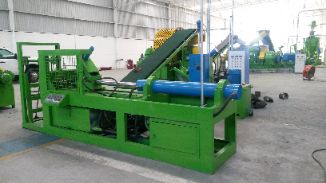
The distance between a shredder's discharge and a granulator's infeed is rarely given much thought, but it is where throughput is won or lost. When the shredder dumps material faster than the granulator can accept it, the result is a pile-up that forces the operator to slow the line or clear a jam. When the flow drops too low, the granulator runs hungry and the whole system wastes energy. A steady handoff keeps both machines running at their intended rates without constant babysitting.
One of the trickiest parts is that shredded stock does not behave like a uniform fluid. It comes off the shredder as a loose, springy mass of film, flake, or regrind, and it tends to bridge or wrap around anything stationary. Relying on a simple chute often turns into a cycle of poke-and-clear. Adding a small buffer hopper with a high/low level sensor gives the granulator a consistent feed while letting the shredder discharge in bursts. A variable-speed conveyor or auger between the two can then respond to the sensor instead of running blind.
Once that intermediate stage is dialed in, the line stops feeling like two separate machines and starts behaving like one continuous process. Operators spend less time clearing bridges or adjusting speeds, and material keeps moving without sudden surges. Even modest changes, such as a shallow incline conveyor with adjustable side rails or a reversing auger to break up clumps, can eliminate most of the friction in the transition and recover capacity that was already sitting in the equipment.
Pulling Steel and Fiber Out Early to Protect Downstream Equipment
Removing steel wire and fiber from the feed stream before it reaches the finer grinding stages is one of the simplest ways to keep maintenance costs down. Shredders, granulators, and classifiers all take a beating when long strands of wire wrap around shafts or when fiber builds up in screens and air ducts. By pulling these materials out early, operators avoid the constant downtime that comes from clearing blockages and replacing worn components.
Early separation also improves the consistency of the remaining rubber or polymer stream. Once the bulk of the steel and fiber is gone, downstream equipment can run at its intended throughput instead of being throttled back to prevent overloads. Magnets, air tables, and vibrating screens placed right after the primary shredder can capture the majority of the contamination before it becomes embedded in the finer material.
In many plants, the decision to move a magnetic separator or a fiber-removal step earlier in the line pays for itself within months. The savings show up not only in reduced parts replacement but also in lower energy draw and less labor spent on manual cleaning. Protecting the expensive fine-grinding and classification equipment starts with a simple rule: get the steel and fiber out while the material is still coarse.
Why Some Lines Run Cooler and Quieter (and Cost Less to Operate)
Much of the heat and noise in a fluid or air line comes down to how smoothly the flow moves through it. Lines with larger internal diameters, smooth bore surfaces, and gently curved fittings reduce turbulence and pressure drop. When the fluid isn't forced through sharp bends or rough transitions, less energy gets converted into waste heat and vibration. That keeps the line itself cooler to the touch and lowers the thermal load on nearby components.
Noise is usually a sign of turbulent flow or mechanical vibration traveling along the line. By choosing materials with a bit of natural damping, or by adding flexible sections at connection points, you interrupt those vibrations before they radiate as sound. Lines that are properly sized for the actual flow rate avoid the high-velocity whistling and hammering that plague undersized or poorly routed systems. It's a design choice that costs little upfront but makes a noticeable difference in workplace comfort.
Lower operating cost follows directly from these two improvements. Reduced pressure drop means pumps and compressors work less to move the same volume, trimming energy bills over time. Cooler running also slows down seal wear and fluid breakdown, so maintenance intervals stretch out and replacement parts last longer. A line that runs quiet and cool is usually a sign that the whole system is balanced, and that balance shows up on the bottom line.
The End Product Spectrum: From Playground Cushion to Rubberized Asphalt
Recycled rubber doesn't arrive at a single destination; it fans out across a surprisingly wide range of end products. At one end of the spectrum sits the soft, shock-absorbing playground cushion—often made from molded crumb rubber or bonded mats—where safety and durability outweigh aesthetics. At the other end lies rubberized asphalt, a road-paving material that blends ground tire rubber with bitumen to reduce cracking and noise. Between these two poles, you'll find running tracks, equestrian footing, landscape mulch, and even molded curb ramps. The common thread is that the raw material shifts from a waste problem to a performance enhancer, but the processing and binding methods vary dramatically.
What makes this spectrum so useful is that it lets manufacturers choose a product based on the particle size, purity, and metal content of the recycled rubber. Playground cushion typically uses finer granules, often with vibrant color coatings and a polyurethane binder, because it must meet strict fall-height and accessibility standards. Rubberized asphalt, by contrast, tolerates a coarser grind and higher levels of residual steel or fiber, since the rubber is partially digested during hot-mix blending. This means the same bale of scrap tires could end up as a bouncy surface under a swing set or as a quieter highway overlay—depending on how it's screened and compounded.
Field performance also diverges sharply. Playground cushions need to stay in place, resist UV fading, and drain well after rain; installers often layer them over a compacted aggregate base with a geotextile separator. Rubberized asphalt, meanwhile, must survive freeze-thaw cycles, heavy truck loads, and oxidation, which is why state DOTs often specify a certain percentage of crumb rubber by weight of binder. Neither product is a silver bullet, but understanding the end product spectrum helps buyers avoid the mistake of assuming all recycled rubber is interchangeable. A mat that works under a slide won't necessarily hold up in a highway wearing course.
Laying Out a Line That Fits Your Space, Feedstock, and Daily Output
When floor space is tight, you learn quickly that a straight-line layout rarely works. We started by mapping the actual walking paths and forklift turns before placing a single machine. The dryer ended up angled near the roll-up door, and the hammermill sat closer to the raw material pile than we originally planned—saving us about forty minutes of material handling each day.
Feedstock behavior dictates more than people expect. Wet, stringy material clumps and bridges in the hopper, so we widened the intake chute and added a vibrating feeder. Dry, dusty feedstock needed an enclosed conveyor to keep airborne fines from settling on motors and gearboxes. Matching the infeed rate to the grinder’s appetite stopped the constant stop-start cycling that was killing our throughput.
Daily output is the number that forces hard choices. A line designed for five tons per shift looks nothing like one built for twenty. We oversized the cooler and screener by about twenty percent so a single surge wouldn’t back up the whole line, and we left space for a second pellet mill without having to move walls later.
FAQ
A reliable line usually combines shredders, granulators, and magnetic separators to break down tires and pull out steel wire before final rubber sizing.
Instead of burning or landfilling tires, the line converts them into reusable rubber granules and powder, cutting pollution and reducing demand for virgin rubber.
Depending on the setup, you can get rubber mulch, crumb rubber of various mesh sizes, clean steel scrap, and textile fiber for separate resale or reuse.
It comes down to motor power, cutting chamber design, screen sizes, and how well the material flow is automated to avoid bottlenecks between stages.
Yes, well-engineered lines use magnets, air classifiers, and vibrating screens to automatically separate steel, fiber, and rubber at different stages.
Focus on proven wear-part life, energy consumption per ton, ease of screen changes, and whether the supplier offers local support for maintenance.
It can be used in many applications like playground surfaces, rubber mats, asphalt modification, and molded products, though high-purity grades are needed for demanding rubber compounds.
Overfeeding, dull blades, incorrectly sized screens, or skipping the steel removal step can contaminate the rubber and cause frequent downtime.
Conclusion
A complete waste tire recycling line starts with a deliberate first cut that reduces whole tires into manageable chunks, then feeds those chunks through a shredder-to-granulator sequence engineered for continuous material movement. This handoff matters because any bottleneck between stages quickly stalls the entire operation. Pulling steel wire and fiber early—right after initial shredding—keeps downstream granulators and screens from wearing out prematurely or jamming. Lines designed this way tend to run cooler and quieter, not because of exotic features, but because fewer contaminants and smoother material flow reduce friction and motor strain. That translates directly into lower energy bills and less maintenance downtime.
The end product spectrum is broader than many operators expect. Clean rubber granules and powders can go into playground cushioning, sports surfaces, or rubberized asphalt, while finer crumb finds use in molded goods and sealants. The key is matching your line layout to your specific feedstock mix and daily output target. A compact facility handling mostly passenger tires will arrange equipment differently than a high-volume plant processing truck and OTR tires. Smart layout choices—like placing the steel removal stage immediately after primary shredding and using gravity feed between granulator and classifier—maximize throughput without adding footprint. In the end, an efficient tire recycling line balances mechanical simplicity, early contaminant removal, and flexible output sizing to turn a waste stream into reliable, marketable rubber.
Contact Us
Contact Person: Chen Zhengwei
Email: [email protected]
Tel/WhatsApp: +86-13963975727
Website: https://www.sfcrubbermachine.com